福州大学-软件工程EE308-2021秋

EE308_LAB9
 墨衍会员 · AI 创作全网分发 墨衍智能分发 通过墨衍一键同步至各平台 可同步平台 CSDN微信公众号微博知乎掘金百家号博客园抖音小红书 你的文章也可以这样分发 墨衍会员 ¥399起/年,写一次发全网
我也要 关注 + 加入社区
Question
Live-streaming sale, through some Internet platforms, is a new way of service using live-streaming technology for close commodity display, consultation response, and shopping guide. Merchants can open their own live broadcast room, or employ professional anchors to recommend goods. At present, not only many celebrities flock into this field, but some big companies’ executives are also frequently involved. Please try to design a comprehensive live-streaming sale system.
(i) List some actors that interact with this system. Explain the relevance of each actor.
Your Answer:
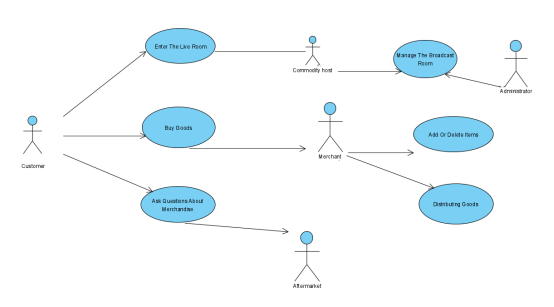
Commodity host is the actor who help to market goods.
Customer is the actor who maybe will purchase goods.
Merchant is the actor who can hire host and delivering goods.
Administrator is the actor who responsible for maintaining order in the room and creating harmonious, regular live rooms.
Aftermarket is the actor who handles the product, answers the customer question.
(ii) Prepare a use case diagram for this system.
Your Answer:
(iii) Prepare a normal scenario for each use case. (i.e. describe each use case in words)
Your Answer:
Name: Enter The Live Room
Description:
- The use case starts when the customer selects Enter the live room.
Name: Buy Goods
Description:
- The customer enters his or her name and address.
- The customer will selects product codes for the desired products.
- The system will supply a product description and price for each
item. - The system will keep a running total of items ordered as they are
entered. - The customer will enter credit card payment information.
- The customer will select Submit.
- The system will verify the information, save the order as
pending, and forward payment information to the accounting
system. - When payment is confirmed, the order is marked Confirmed, an
order ID is returned to the customer, and the use case ends.
Name: Ask Questions About Merchandise
Description:
- Customer can ask for details of the product.
- Customers can also ask about shipping information about the product and about the service after sales.
Name: Manage The Broadcast Room
Description:
- The Commodity host and administrator can fast bad patrons.
- The administrator can manage the poor behavior of the host.
Name:Add Or Delete Items
Description:
- Merchants can select the desired cargo upper or lower rack as needed
Name: Distributing Goods
Description:
- Merchants provide commodity orders to customers
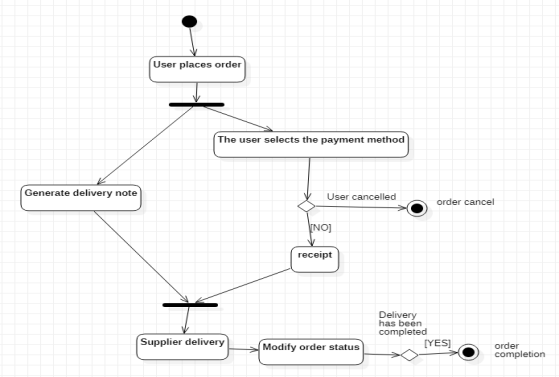
(iv) Prepare sequence diagrams or activity diagrams for primary scenarios. By the way, each scenario can be described by a sequence diagram or an activity diagram, but both diagrams must be used in the question.
Your Answer:This is a sequence diagram and activity diagram of the purchase of goods.
activity diagram:
sequence diagram:
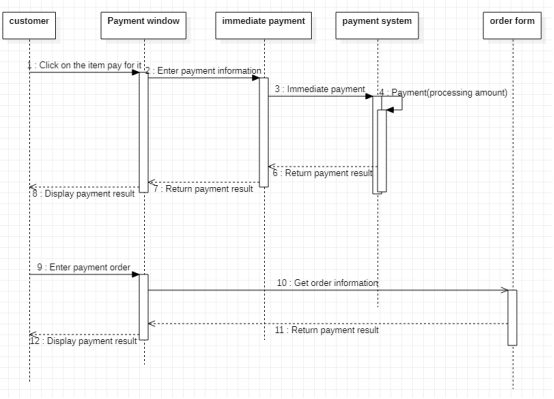
(v) Prepare a class diagram for this system. Explain which principles of object-oriented are applied in your design.
Your Answer:
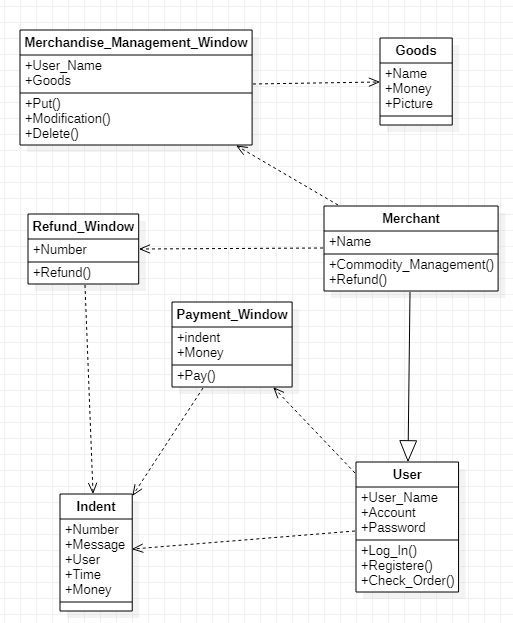
Use Single Responsibility Principle.
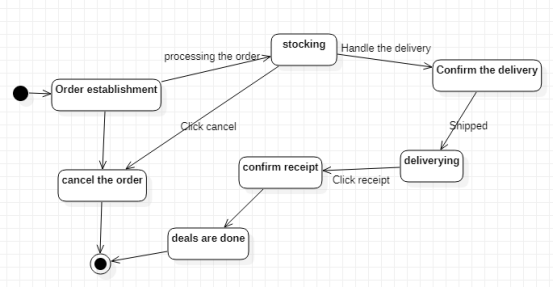
(vi) Prepare state diagrams for primary classes.
Your Answer:This is a state diagram of placing an order and receiving the goods
(vii) Write the skeleton code corresponding to the class diagram in C++, Java, Python, or C#.
Your Answer:
Merchandise_Management_Window
import java.util.*;
public class Merchandise_Management_Window {
    public Merchandise_Management_Window() {
    }
    public void User_Name;
    public void Goods;
    public void Put() {
        // TODO implement here
    }
    public void Modification() {
        // TODO implement here
    }
    public void Delete() {
        // TODO implement here
    }
}
Indent
import java.util.*;
public class Indent {
    public Indent() {
    }
    public void Number;
    public void Message;
    public void User;
    public void Time;
    public void Money;
}
Goods
import java.util.*;
public class Goods {
    public Goods() {
    }
    public void Name;
    public void Money;
    public void Picture;
}
Merchant
import java.util.*;
public class Merchant extends User {
    public Merchant() {
    }
    public void Name;
    public void Commodity_Management() {
        // TODO implement here
    }
    public void Refund() {
        // TODO implement here
    }
}
Payment_Window
import java.util.*;
public class Payment_Window {
    public Payment_Window() {
    }
    public void indent;
    public void Money;
    public void Pay() {
        // TODO implement here
    }
}
Refund_Window
import java.util.*;
public class Refund_Window {
    public Refund_Window() {
    }
    public void Number;
    public void Refund() {
        // TODO implement here
    }
}
User
import java.util.*;
public class User {
    public User() {
    }
    public void User_Name;
    public void Account;
    public void Password;
    public void Log_In() {
        // TODO implement here
    }
    public void Registere() {
        // TODO implement here
    }
    public void Check_Order() {
        // TODO implement here
    }
相关推荐
EE-308 LAB4 final version.7z
这是本次实验的压缩包
EE308-Lab8-AlphaSprint-Day7
EE308-Lab8-AlphaSprint-Day7Feedback From Members1. Beichen, ZhouModulePersonal SummaryCode & Results2. Yuwei, JiangModulePersonal SummaryCode & Results3. Yifan, ZhuModulePersonal Summary4. Yifan, ShenModulePersonal SummaryCode & Results5. Shenk
【十万字拆解】从零开始实现GPT-2(完整版)
本文是一篇 14 万字、从零硬核实现 GPT 的保姆级指南。内容全面覆盖四个阶段:①从最基础的 Bigram 语言模型切入,跑通数据处理与训练闭环;②仿照 Transformer 架构,深度研究 Multi-Head Attention、残差网络、LayerNorm 及 Dropout 的底层数学与代码实现;③从零构建BPE 分词器,对齐 GPT-2 规范;④从头搭建 GPT-1/2 工业级预训练流程,包含混合精度、梯度累积等十余项硬件级工程调优,并在 AutoDL 算力平台上从0开始训练!适合所有层次!
【信息科学与工程学】【物理/化学科学和工程技术】知识体系073——电学基础04
。
不平衡电网下的svg无功补偿,级联H桥svg无功补偿statcom,采用三层控制策略(Simulink仿真实现)
内容概要:本文围绕不平衡电网条件下采用级联H桥结构的静止无功发生器(SVG/STATCOM)开展无功补偿技术的研究,提出基于三层控制策略的系统设计方案,并利用Simulink平台构建了完整的仿真模型。系统通过电压外环、电流内环及功率协调控制层,实现对无功功率的快速、精确动态补偿,有效抑制电网不平衡带来的负序分量,提升电能质量与系统稳定性。文档详尽阐述了仿真模型的搭建流程、核心控制算法的设计原理,并附有说明报告与参考文献,具有较强的理论深度与工程实践价值,适用于电力电子与新能源领域的科研与实际应用。; 适合人群:电气工程、电力电子及相关专业的高校研究生、科研人员,以及从事电能质量治理、新能源并网、柔性交流输电系统(FACTS)等方向的工程技术人员。; 使用场景及目标:①深入研究不平衡电网环境下无功补偿的控制机理与负序抑制方法;②掌握级联H桥STATCOM的拓扑结构、工作特性及建模技巧;③复现并优化三层协同控制策略,提升系统的动态响应与鲁棒性;④为相关科研课题、毕业设计或工程项目提供可靠的仿真验证平台与技术支撑。; 阅读建议:建议结合所提供的说明报告与参考文献,逐步完成Simulink仿真模型的搭建,重点关注各控制层(如功率外环、电压中环、电流内环)的参数设计与逻辑衔接,通过设置不同故障工况(如单相短路、电压跌落)进行仿真测试,对比分析补偿前后电网性能变化,从而深入理解SVG在复杂电网环境下的控制逻辑与应用优势。