


183
社区成员
 发帖
发帖 与我相关
与我相关 我的任务
我的任务
 分享
分享| The Link Your Class | https://bbs.csdn.net/forums/MUEE308FZ?category=0 |
|---|---|
| The Link of Requirement of This Assignment | https://bbs.csdn.net/topics/603748107 |
| The Aim of This Assignment | Unit Test Tutorial (for python) |
| MU STU ID and FZU STU ID | 19105185_831901317 |
This lab is aim to learn something about unit test. This lab contains task of python and java. I choose python with the toolbox called unittest which is already inside python.
lab_11.py
import unittest, random


# Test Class
class MyClass(object):

    @classmethod
    def sum(self, a, b):
        return a + b

    @classmethod
    def div(self, a, b):
        return a / b

    @classmethod
    def retrun_None(self):
        return


class MyTest(unittest.TestCase):
    # assertEqual()
    def test_assertEqual(self):
        # test if a+b equals sum or not
        try:
            a, b = 1, 2
            sum = 3
            self.assertEqual(a + b, sum, 'assert failed!,%s + %s != %s' % (a, b, sum))
        except AssertionError as e:
            print(e)

    # assertNotEqual()
    def test_assertNotEqual(self):
        # fix missing three lines of codes below ‘try’, test if b-a equals res or not
        try:
            a, b = 1, 2
            res = 4
            self.assertNotEqual(a - b, res, 'assert failed!,%s + %s != %s' % (a, b, res))
        except AssertionError as e:
            print(e)

        # assertTrue()
    def test_assertTrue(self):

        try:
            self.assertTrue(1 == 1, "False expression")
        except AssertionError as e:
            print(e)

    # assertFalse()
    def test_assertFalse(self):
        # fix missing codes below ‘try’, only a line of codes needed
        try:
            self.assertFalse(2 == 1, "False expression")
        except AssertionError as e:
            print(e)

    # assertIs()
    def test_assertIs(self):
        # test a and b are totally same
        try:
            a = 12
            b = a
            self.assertIs(a, b, "%s and %s are not same" % (a, b))
        except AssertionError as e:
            print(e)

    # assertIsInstance()
    def test_assertIsInstance(self):
        # fix missing codes below ‘y=object’ to test type(x) != y, only a line of codes needed
        try:
            x = MyClass
            y = object
            self.assertIsInstance(x, y, "%s and %s are not same" % (type(x), y))
        except AssertionError as e:
            print(e)

if __name__ == '__main__':
    # run unittest
    unittest.main()
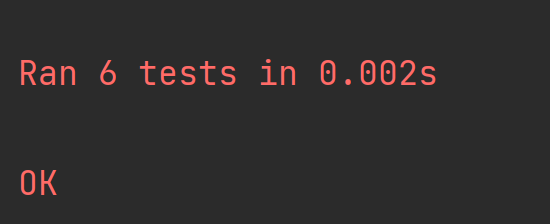
The result of running through the code is:
Calc.py
class Calc(object):

    def add(self, *d):
        #
        result = 0
        for i in d:
            result += i
        return result

    def mul(self, *d):
        #
        result = 1
        for i in d:
            result = result * i
        return result


    def sub(self, a, *d):
        #
        result = a
        for i in d:
            result = result - i
        return result


    def div(self, a, *d):
        #
        result = a
        for i in d:
            result = result / i
        return result
TestCalc.py
# TestCalc.py

import unittest
import random
from Calc import Calc

class TestCalcFunctions(unittest.TestCase):

    def setUp(self):
        self.c = Calc()
        print("setup completed!")

    def test_sum(self):
        self.assertTrue(self.c.add(1, 2, 3, 4) == 10)

    def test_sub(self):
        self.assertTrue(self.c.sub(10, 3) == 7)
        # fix a line of codes to test c.sub(self, a, *b) method

    def test_mul(self):
        self.assertTrue(self.c.mul(3, 4) == 12)
        # fix a line of codes to test c.mul(self, *b) method

    def test_div(self):
        self.assertTrue(self.c.div(4, 2) == 2)
        # fix a line of codes to test c.div(self, a, *b) method

    def tearDown(self):
        print("test completed!")

    def tearDown(self):
        print("tearDown completed")

if __name__ == '__main__':
    unittest.main()
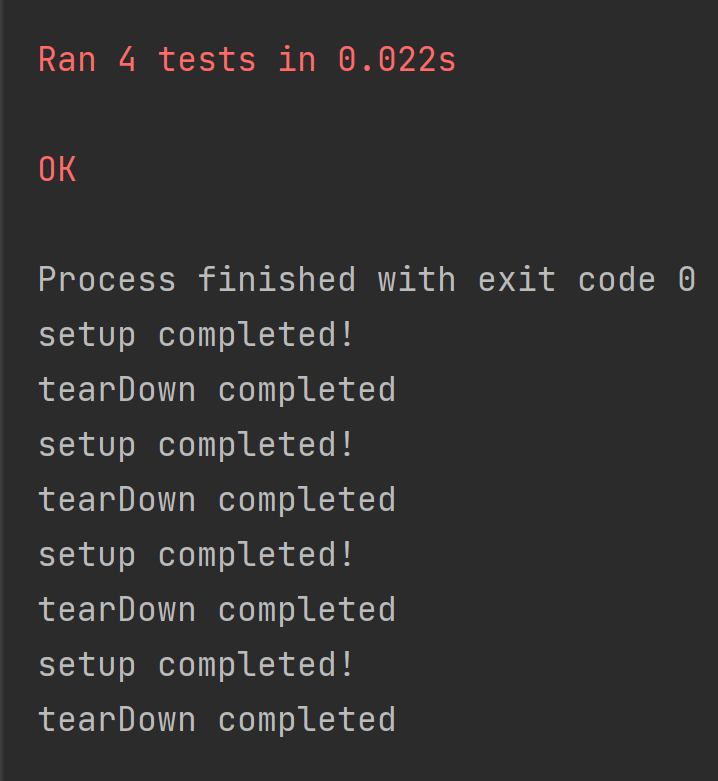
The result of running through the code is:
lab11_3.py
# unittest_suite.py

import random
import unittest
from TestCalc import TestCalcFunctions


class TestSequenceFunctions(unittest.TestCase):
    def setUp(self):
        self.seq = list(range(10))

    def tearDown(self):
        pass

    def test_choice(self):
        # chose an element from seq randomly
        element = random.choice(self.seq)
        # check element is truly in the sequence
        self.assertTrue(element in self.seq)

    def test_sample(self):
        # if codes raise exception
        with self.assertRaises(ValueError):
            random.sample(self.seq, 20)

        for element in random.sample(self.seq, 5):
            self.assertTrue(element in self.seq)


class TestDictValueFormatFunctions(unittest.TestCase):
    def setUp(self):
        self.seq = list(range(10))

    def tearDown(self):
        pass

    def test_shuffle(self):
        # shuffle sequence
        random.shuffle(self.seq)
        self.seq.sort()
        self.assertEqual(self.seq, list(range(10)))
        # check TypeError exception
        self.assertRaises(TypeError, random.shuffle, (1, 2, 3))

if __name__ == '__main__':
    # get all test methods start with ‘test’ and return a suite
    suite1 = unittest.TestLoader().loadTestsFromTestCase(TestSequenceFunctions)
    # please fix another two suite, suite2 of TestCalcFunctions and suite3 of TestDictValueFormatFunctions
    suite2 = unittest.TestLoader().loadTestsFromTestCase(TestCalcFunctions)
    suite3 = unittest.TestLoader().loadTestsFromTestCase(TestDictValueFormatFunctions)
    # put more test class into suite
    # you can change suites’ order, like [suite1, suite2, suite3]
    suite = unittest.TestSuite([suite2, suite1, suite3])
    # set verbosity = 2 you could get more detailed information
    unittest.TextTestRunner(verbosity=2).run(suite)
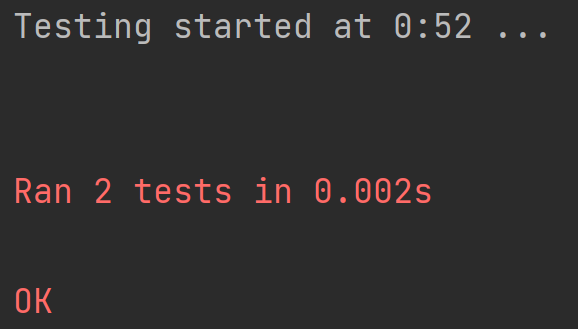
The result of running through the code is:
lab11_4.py
# encoding=utf-8

import random, sys, unittest


class TestSeqFunctions(unittest.TestCase):
    a = 1

    def setUp(self):
        self.seq = list(range(20))

    @unittest.skip("skipping")  # skip this method anyway
    def test_shuffle(self):
        random.shuffle(self.seq)
        self.seq.sort()
        self.assertEqual(self.seq, list(range(20)))
        self.assertRaises(TypeError, random.shuffle, (1, 2, 3))

    # add a line of annotation that skip this method if a>5
    @unittest.skipIf(a > 5, "skip this method if a>5")
    def test_choice(self):
        element = random.choice(self.seq)
        self.assertTrue(element in self.seq)

    # add a line of annotation that skip if not in linux platform
    @unittest.skipIf(sys.platform != "Linux", "skip Linux")
    def test_sample(self):
        with self.assertRaises(ValueError):
            random.sample(self.seq, 20)
        for element in random.sample(self.seq, 5):
            self.assertTrue(element in self.seq)


if __name__ == "__main__":
    # unittest.main()
    suite = unittest.TestLoader().loadTestsFromTestCase(TestSeqFunctions)
    suite = unittest.TestSuite(suite)
    unittest.TextTestRunner(verbosity=2).run(suite)
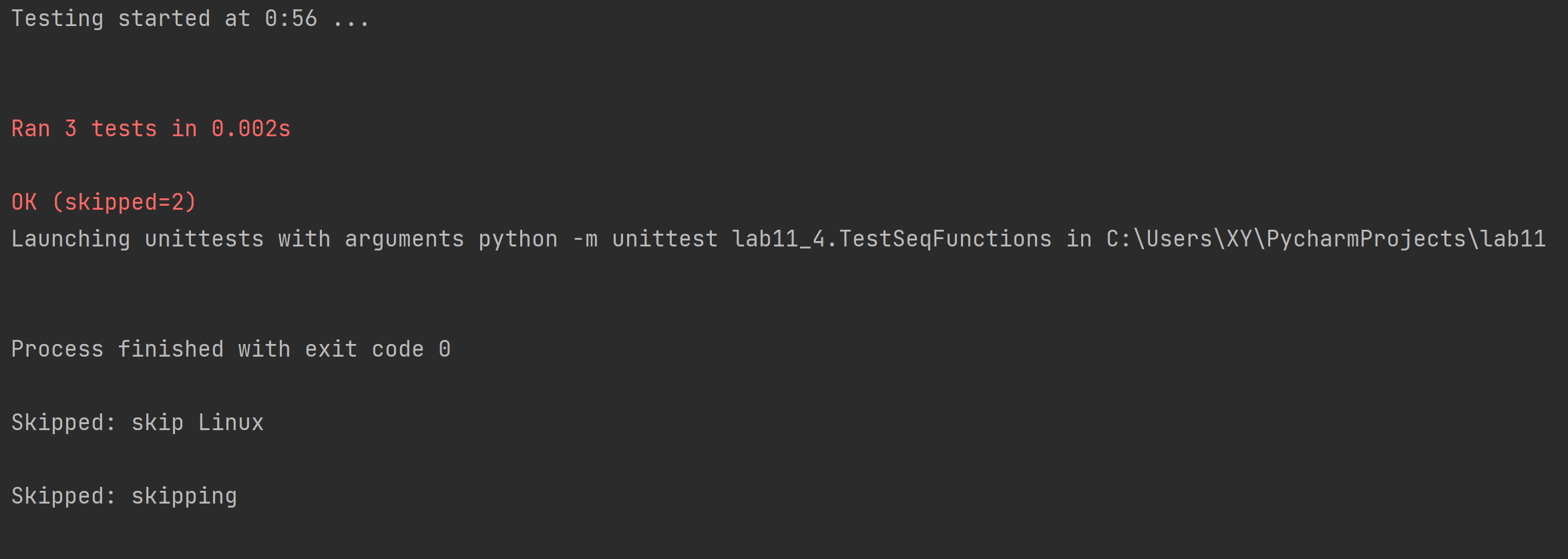
The result of running through the code is:
lab11_5.py
# encoding=utf-8

import unittest
from Calc import Calc


class MyTest(unittest.TestCase):
    @classmethod
    def setUpClass(self):
        print("init Calc before unittest")
        self.c = Calc()

    # rename the four methods bellow, make sure print queue will be :
    # run add()
    # run sub()
    # run mul()
    # run div()

    # P.S.: test case must starts with ‘test’
    def test_1_add(self):
        print("run add()")
        self.assertEqual(self.c.add(1, 2, 12), 15, 'test add fail')

    def test_2_sub(self):
        print("run sub()")
        self.assertEqual(self.c.sub(2, 1, 3), -2, 'test sub fail')

    def test_3_mul(self):
        print("run mul()")
        self.assertEqual(Calc.mul(self.c, 2, 3, 5), 30, 'test mul fail')

    def test_4_div(self):
        print("run div()")
        self.assertEqual(Calc.div(self.c, 8, 2, 4), 1, 'test div fail')


if __name__ == '__main__':
    unittest.main()
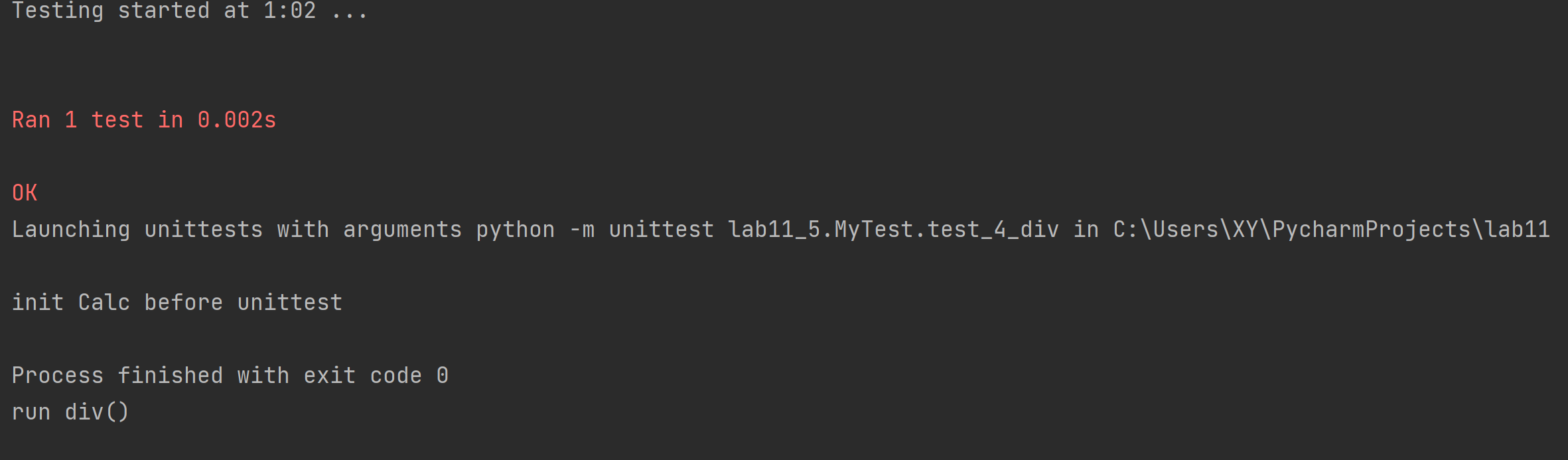
The result of running through the code is:
lab11_6.py
import time
import timeout_decorator
import unittest


class timeoutTest(unittest.TestCase):

    # set a time decorator(annotation) which will be triggered after 5s’ running
    @timeout_decorator.timeout(5)
    def testtimeout(self):
        print("Start")

        for i in range(1, 10):
            time.sleep(1)
            print("%d seconds have passed" % i)


if __name__ == "__main__":
    unittest.main()
There is no virtual machine on my computer, so I can't complete the last task. In lack of the module "timeout_decorator", we can not execute the code correctly.
Through this experiment, I learned how to test Python code, and knew the importance and convenience of testing for code.

