2401_MU_SE_FZU

First assignment-- front-end and back-end separation contacts programming
 墨衍会员 · AI 创作全网分发 墨衍智能分发 通过墨衍一键同步至各平台 可同步平台 CSDN微信公众号微博知乎掘金百家号博客园抖音小红书 你的文章也可以这样分发 墨衍会员 ¥399起/年,写一次发全网
我也要 关注 + 加入社区
墨衍会员 · AI 创作全网分发 墨衍智能分发 通过墨衍一键同步至各平台 可同步平台 CSDN微信公众号微博知乎掘金百家号博客园抖音小红书 你的文章也可以这样分发 墨衍会员 ¥399起/年,写一次发全网
我也要 关注 + 加入社区First assignment-- front-end and back-end separation contacts programming
To avoid missing homework content, here is a checklist for students to quickly review
Programming implementation
Basic function implementation
Deployment
Release version released
Write a blog and submit a blog before the deadline
Include job description and directory
Check scoring criteria
Due to the first time using community Posting to submit homework, many students did not submit correctly, the following is a gif demo:
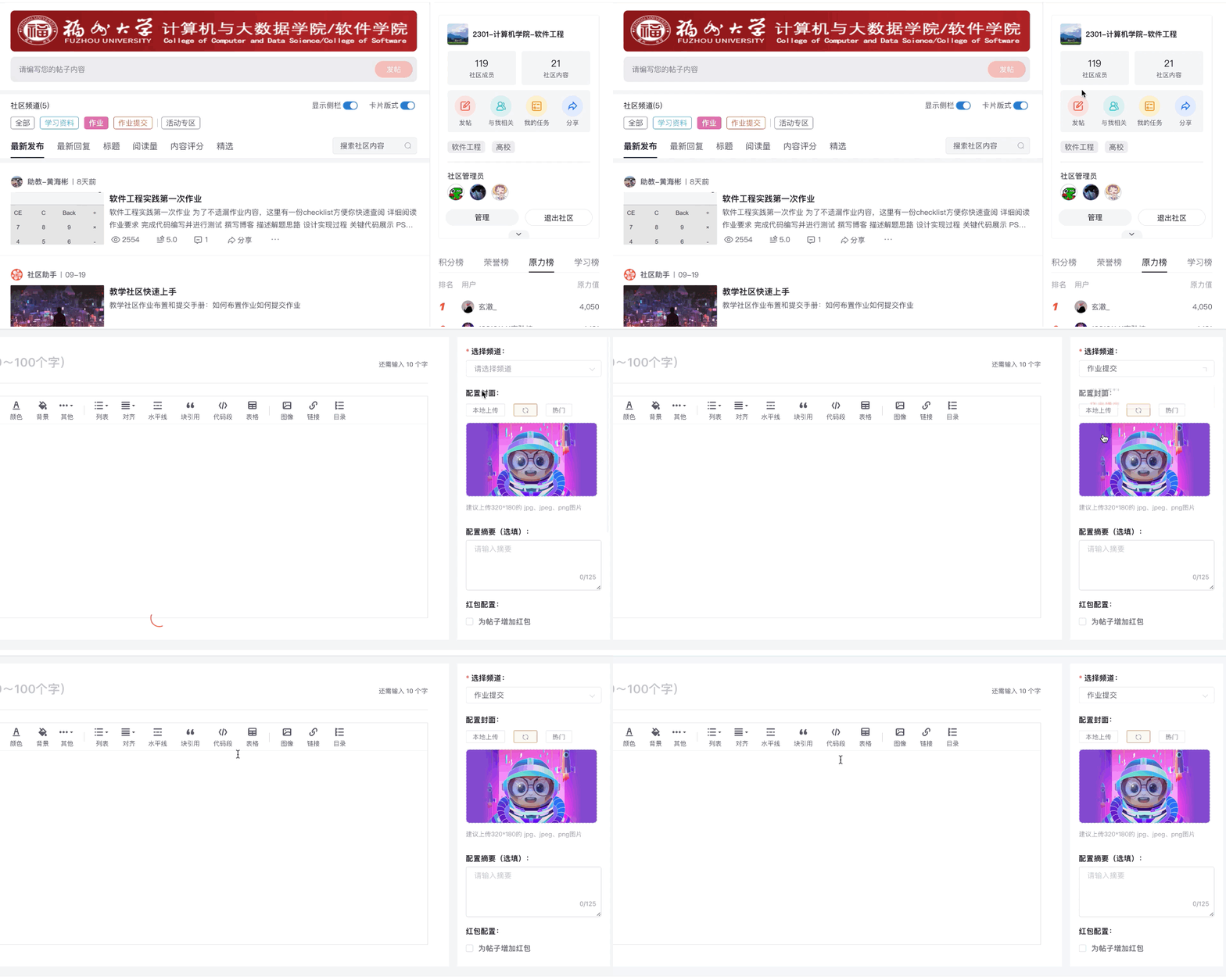
This assignment allows the use of any visualization technology: web, Android, applet of WeChat, etc., but to reflect the front and back end separation to achieve the following functions.
Deadline
The deadline for this assignment is: November 1, 2024 23:59
Note: The blog needs to be reviewed after publication, please remember to publish the blog in advance to avoid affecting the assignment submission.
Part1:Homework content
1. Basic contacts functions
- Function 1: add
- Basic operations for adding contacts, including name, phone number, etc. and store contacts information in a back-end database
- Function 2: modify
- Modify the contacts information. must be read from the back-end database, can not use the cache.
- Function 3: delete
- Requirement as above
2. Other instructions
- About Extended features
- You can extend the function you want to extend, the extension function will be recorded as additional points, for the extension function please describe in detail in the blog.
- About development
- It is recommended to develop based on Web, using Web frameworks, such as common JSP, Servlet, spring series, flask, php, express and so on. Allows the use of any visualization technology: web, Android, wechat mini program, etc. But the front and back ends should be separated.
- The technology used should be platform compatible and not dependent on the specific environment.
- The main objective of this assignment is to achieve functionality, and technical considerations only count for a certain number of points. Do not use the prototype tool to generate code, set 0 points directly who gets caught.
Part2:Coding requirement
1.Use of Github
This assignment will continue to follow Github, which requires the development technology of front end and back end separation. Please submit the front end and back end separately in different warehouses, and the link of code warehouse in the blog is convenient for teaching assistants to check.
Frontend Project Directory Structure
|-Student ID_concacts_frontend |- src |- concacts.html/.xml/.wxml |- ......other files |- README.md |- codestyle.md
Backend Project Directory Structure
|-Student ID_concacts_backend |- src |- ... |- controller |- concacts.java/.go/.py... |- ....other files |- README.md |- codestyle.md
2.Code Standards Development
The assignment for this time still requires the creation of a codestyle.md as a code standard document. However, it is required that this code standard be derived from mainstream official standards or those recommended by major companies, and the source should be indicated at the top of the code standard document.
3.Technologies and Frameworks
The current assignment does not restrict the choice of programming language, libraries, or frameworks to be used.
Part3:Blog Writing Requirements
- Assignment Description
- You can include the Github repository address at the beginning of your article. Here's how you can incorporate it into your blog post's introduction:
- Before starting the implementation of the program, record your estimated and actual time spent on the development of various modules of the program in the PSP table. After implementing the program, record the actual time spent in the PSP table.
- Provide the access link after deploying the project to the cloud server.
- Present your finished product, requiring the provision of 10 or more images, or the use of GIFs or embedded videos to demonstrate the required functionality of the assignment. Each displayed image should be accompanied by a brief text description.
- Describe the design and implementation process and provide a functional structure diagram.
- Code explanation. Display the key code of the project and explain the thought process.
Part4:Assignment Grading Criteria and Evaluation Rule
The total score for this assignment is 100 points.
(30') Basic Requirements [Covering Course Objective 2]
- (15‘) Blog Formatting, using Markdown formatting; Provide the Github repository link correctly and the code standard link
- (15‘) Function Analysis and Design of the Implementation Process
(70‘) Coding Implementation [Covering Course Objective 4]
- (20‘) Frontend Page Presentation
- (50‘) Backend Functionality Implementation
- (20‘) Feature 1: Add
- (20‘) Feature 2: Modify
- (10‘) Feature 2: Delete
(Extra Credit: 0' to 10) Additional Features
Part5:Rules & Format
- To facilitate readability and assist teaching assistants in grading, please provide a table of contents at the beginning of your blog as a content index. Ensure that the table of contents can navigate correctly!
Be sure to include the following major headings; similar meanings are acceptable, and you can personalize your own titles:
- Git Repository Link and Code Standards Link
- PSP Table
- Presentation of the Finished Product
- Design and Implementation Process
- Code Explanation
- Personal Journey and Learnings
- To help teachers or teaching assistants from other schools understand the course situation, please add a format description at the beginning of the assignment:
| Course for This Assignment | |
|---|---|
| Assignment Requirements | |
| Objectives of This Assignment | |
| Other References | ... |
- Submission Rules
- The submission time for the blog post is based on the class assignment page; the time of code submission is based on Github.
- Submitting before the deadline will be graded based on the actual score.
- If the post is under review (the post shows 404) after publication, you can first submit the link to the assignment page before the deadline and wait for it to be approved.
- Excuses like upload failure or network issues for late submissions will not be accepted.
- Late Submission: Submitting within two days after the deadline is considered a late submission, and the score will be 50% of the actual score; forgetting to submit the assignment and late submissions will be penalized equally.
- Missed Submission: Failing to submit within two days after the deadline will result in a score of 0.
- Plagiarism: When the teaching assistant finds that two blog posts have text/images/code that are too similar, both blog posts will be considered as plagiarism, and both will receive a -100% score (note that it's negative!).
- Falsifying Submissions: Although the assignment blog may not be completed, submitting it early to reserve a spot will be considered a falsified submission, and the score will be 0.
Note: For assignments submitted in advance, if you can actively respond to feedback from teaching assistants and make corresponding revisions before the deadline, these improvements will also be taken into consideration during subsequent grading. Being well-prepared in advance has many benefits~
- Notices
- Class group announcements are also part of the assignment requirements. Please check group announcements in a timely manner. If you need to fill out relevant information in the group and fail to do so before the deadline, you will be penalized by 50% of the actual score. If you have any questions about the assignment, please raise them in the class group three days before the deadline. If there are any changes to the assignment requirements by the teaching assistants, they will be announced in the group, so please be sure to check and improve your assignment according to the new requirements. Please respond promptly to feedback from the teacher or teaching assistant. Even after submitting the assignment, you should pay attention to announcements from teaching assistants in the class group!
- Clarifications
- If you find any unclear or misunderstood parts of the assignment, you can leave a comment below this blog post or directly ask questions in the QQ group or WeChat group.
相关推荐
front-end-portfolio:第一前端组合
欢迎来到我的投资组合! :waving_hand: 该项目是由爱德华·加西亚·阿尔皮( Eduard Garcia Arpi)创建的 在这里您可以检查 感谢您检阅此前端产品组合。
front-end-QA-to-interview, 前端开发面试问题及答案整理.zip
front-end-QA-to-interview, 前端开发面试问题及答案整理
front-end-book:前端开发人员知识点
网站前端知识点 学不动了〜 目录
ai game programming wisdom vol 1
Learn how AI experts create intelligent game objects and characters with this first volume in the AI Game Programming Wisdom series. This unique collection of articles gives programmers and developers access to the insights and wisdom of over thirty AI pros. Each article delves deep into key AI game programming issues and provides insightful new ideas and techniques that can be easily integrated into your own games. Everything from general AI architectures, rule based systems, level-of-detail AI, scripting language issues, to expert systems, fuzzy logic, neural networks, and genetic algorithms are thoroughly covered. If you're a game programmer (AI/logic, front-end, user interface, tools, graphics, etc.) this comprehensive resource will help you take your skills and knowledge to the next level.
First-Step-Blog
第一步博客 Django Full front back博客 如何使用 克隆项目和安装要求 确保您已经安装了python3和git。 $ git clone https://github.com/siyonteam/First-Step-Blog && cd First-Step-Blog $ pip install -r requirements.txt