


165
社区成员
 发帖
发帖 与我相关
与我相关 我的任务
我的任务
 分享
分享| Course for This Assignment | 2501_MU_SE_FZU |
|---|---|
| Where are the requirements for this assignment? | Fifth Assignment——Alpha Sprint |
| Team Name / Personal ID | FocusFlow |
| The goal of this Assignment | FocusFlow Sprint Summary Essay |
| Other Reference | 1. Method of Construction (《构建之法》) |
| SN | Time Arrangement | What Needs To Be Done |
|---|---|---|
| 1 | 12.13 (1 day) | Login and Registration |
| 2 | 12.14-12.15 (2 days) | Task Modification, Tagging, and Tategorization |
| 3 | 12.16-12.17 (2 days) | Focus Mode, Countdown Function, Learning Duration Statistics |
| 4 | 12.18-12.19 (2 days) | Home Page Function (Check-in Function) |
| 5 | 12.20-12.21(2 days) | User Report Module, Synchronized Recording. |
| 6 | 12.22 (1 day) | Web Testing |
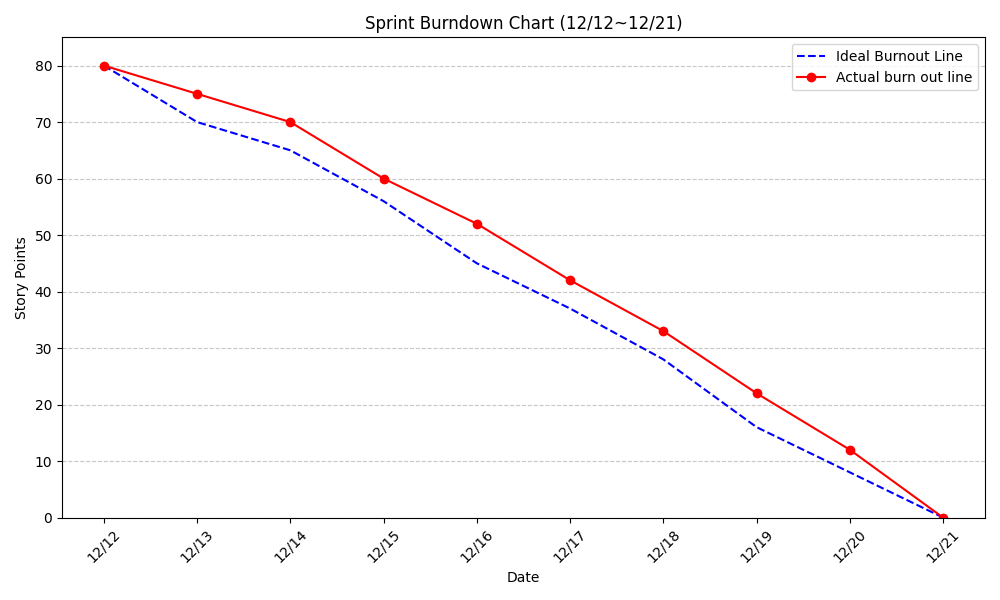
We completed every part and realized every function according to the plan.
Below is our burndown diagram and final run video:
📹 Demo Video
🔗Project website:http://116.62.193.147/
Member 1: Yuxiang Xie
Student ID (FZU):832301327
Student ID (MU):23124237
CSDN Profile: https://blog.csdn.net/2302_79919049?type=bbs
Gains and insights: In the project, I take the lead in interface prototyping, user interaction process definition and acceptance criteria formulation, and deeply realize that prototype is the core bridge for cross-team collaboration. In the sprint phase, we need to respond quickly to the feedback from product, development and testing teams, and align the details such as coherence of interaction logic and accuracy of prototype visualization, to ensure that the design not only meets the user's needs, but also adapts to the feasibility of technical landing. The quantitative definition of acceptance criteria (e.g. interaction response time, operation path integrity) provides a clear basis for testing and verification, effectively reducing rework in the sprint stage. This practice made me realize that accurate prototyping and clear acceptance criteria are the key to ensure delivery quality and efficiency.
Member 2: Pengxiang Hu
Student ID (FZU):832301309
Student ID (MU):23126566
CSDN Profile: https://blog.csdn.net/2401_83837877?type=bbs
Gains and insights: During the period when I was responsible for interface prototyping, interaction flow design, and acceptance criteria, I focused on “user experience landing” and “cross-team collaboration efficiency”. During the sprint phase, time is tight, so we need to quickly iterate the prototype while linking the visual design and development teams to confirm the feasibility of the interaction, and resolve the conflict between the prototype and the technical implementation through focused communication. Acceptance criteria need to take into account functional integrity and test enforceability, especially in the sprint phase, clear rules can greatly improve the efficiency of problem feedback. This experience made me realize that prototyping is not only a carrier of user experience, but also a core coordination tool to ensure efficient project delivery.
Member 3: Jianyuan Wu
Student ID (FZU):832302126
Student ID (MU):23126787
CSDN Profile: https://blog.csdn.net/2401_87495314?type=bbs
Gains and insights: In the project, I was responsible for the optimization and standardization of user experience requirements such as multi-language support and theme personalization. During the sprint phase, we need to quickly link up the design, development and testing teams to align the details such as language character encoding adaptation and theme style compatibility, so as to avoid affecting user acceptance due to experience differences. Considering the tight iteration in the sprint phase, I output the standardized adaptation manual in advance, clarifying the multilingual copy specification and theme switching interaction guidelines, and at the same time, linking with the testing team to incorporate automated compatibility testing to ensure the consistency of experience. This practice made me realize that UX standardization needs to take into account both functionality and user perception, and cross-team collaboration is the key to efficient delivery in the sprint phase.
Member 4: Hongzhi He
Student ID (FZU):832302220
Student ID (MU):23125390
CSDN Profile: lhttps://blog.csdn.net/2401_82721023?type=bbs
Gains and insights: Focusing on the standardization of UX requirements for multi-language support and theme personalization, I was deeply aware of the core value of this type of requirements for product universality. During the sprint phase, I had to quickly respond to feedback from different teams, and quickly finalize the solution through focused communication to address issues such as multilingual layout adaptation and theme style loading performance. Since there was no more room for adjustment, I gave priority to promoting the standardization of requirements, ensuring that the smoothness of multi-language switching and the compatibility of theme personalization were included in the CI/CD testing process, and avoiding potential experience loopholes in advance. This experience made me understand that UX requirement optimization needs to consider the technical feasibility beforehand, and standardization and efficient collaboration are the core to ensure the delivery quality in the sprint stage.
Member 1: Hantao Wu
Student ID (FZU):832302129
Student ID (MU):23125586
CSDN Profile: https://blog.csdn.net/taohuaracing?type=bbs
Gains and insights: In the project, I led the detailed requirement definition of user account system, authentication and authorization module. By sorting out the business scenarios and dismantling the user rights hierarchy, I gained an in-depth understanding of the critical impact of the rigor of the requirements definition on the subsequent development, and I especially appreciated the core role of the authentication and authorization mechanism in guaranteeing the security of the system. During the process, I learned to balance functional utility and security compliance, and confirmed the requirement boundaries through repeated communication, effectively reducing potential differences. This experience enabled me to improve my requirement analysis and logic dismantling ability, and in the future, I will pay more attention to incorporating security design thinking into the requirement stage, so as to build a solid foundation for the stable operation of the system.
Member 2: Zhihao Liu
Student ID (FZU):832301110
Student ID (MU):23126596
CSDN Profile: https://blog.csdn.net/Destinyawareness?type=bbs
Gains and insights: In this project, I took the lead in defining the detailed requirements for the user account system, authentication and authorization modules. By disassembling user operation scenarios and sorting out the logical hierarchy of permissions, I deeply realized that the accuracy of requirements definition directly determines the security and ease of use of the system. During the process, through repeated discussions with the development and testing teams, I learned to take into account the feasibility of technical implementation and the smoothness of user experience while meeting the functional requirements. This experience has not only improved my requirement disassembly and logical analysis skills, but also made me realize the importance of the authentication and authorization module as the cornerstone of system security. In the future, I will pay more attention to the introduction of scenario-based thinking in the requirements stage to further strengthen the implementability and foresight of requirements.
Member 3: Yitan Fang
Student ID (FZU):832302110
Student ID (MU):23125578
CSDN Profile: https://blog.csdn.net/2401_83199391?type=bbs
Gains and insights: During the project sprint phase, I was responsible for learning the business logic and data model design of the task management and labeling system. In this phase, we need to efficiently link multiple teams to quickly align the requirements for task flow rules, label mapping logic and other details to avoid ambiguity. Since there is no room for large-scale refactoring, the design prioritizes compatibility and testability, adapts to automated testing and CI/CD processes, and exposes data correlation loopholes in advance. Practice has taught me that the rigor of the underlying design and the efficiency of cross-team collaboration is the key to guaranteeing high-quality project delivery.
Member 4: Jiazhuo He
Student ID (FZU):832302130
Student ID (MU):23124768
CSDN Profile: https://blog.csdn.net/2301_80367395?type=bbs
Gains and insights: During the project, I was responsible for learning the business logic and data model design of the task management and labeling system. During the sprint phase, we need to work with multiple teams to quickly align the core details such as task association rules and labeling classification system to ensure that the design has both business suitability and technical practicability. Due to time constraints, the design focuses on data model standardization and logic closure, and adapts automated testing and CI/CD processes in advance to help quickly expose potential problems. This practice made me deeply realize that the rigor of the underlying design and efficient cross-team communication are the key to ensure system stability and delivery efficiency.
Member 5: Shengpeng Yang
Student ID (FZU):832301120
Student ID (MU):23126434
CSDN Profile: https://blog.csdn.net/2401_83255022?type=bbs
Gains and insights: During the project, I focused on defining functional and non-functional requirements (performance, security) for the Tomato Clock Timer, Achievement Record and Report Generation modules. During the sprint phase, we need to quickly align the details with multiple teams, especially performance optimization and data security validation, which need to be done in advance. By incorporating automated test scenarios into the design requirements and adapting the CI/CD process, performance bottlenecks and security vulnerabilities are efficiently exposed. From my practice, I know that the precise definition of non-functional requirements is the core of system stability, and cross-team focused communication is the key to high quality delivery in the sprint phase.
Member 6: Chenhe Zhu
Student ID (FZU):832301108
Student ID (MU):23125047
CSDN Profile: https://blog.csdn.net/2401_87000327?type=sub&subType=column
Gains and insights: Responsible for the full-dimension requirement control of Tomato clock, performance record and report generation module, and deeply understand the importance of synergy between functional and non-functional requirements. During the sprint phase, we need to respond quickly to the feedback from the development and testing teams, and avoid requirement deviation through high-frequency communication on key points such as timing accuracy, data encryption, and report generation efficiency. With the help of continuous integration process to realize the automation of requirements validation, and check the performance shortcomings and security risks in advance. This experience made me realize that requirement definition needs to take into account the functional integrity and feasibility of landing, and efficient cross-team collaboration is the core of avoiding delivery risks.
Member 1: Feiiie Zheng
Student ID (FZU):832301306
Student ID (MU):23126078
CSDN Profile: https://blog.csdn.net/2302_79874906?type=bbs
Gains and insights: In the project, I was responsible for the requirements testability work, from the initial intervention to write the detailed acceptance validation guidelines for each functional requirement, to formulate the overall validation plan and participate in the whole process of review. I deeply realized that clear testing standards can greatly reduce the risk of requirement ambiguity. At the sprint stage, clear validation criteria provide support for efficient testing, and cross-team reviews ensure that requirements are aligned with development and testing. This practice made me realize that requirement testability is the key to guarantee the quality and efficiency of delivery.
Member 2: Weixiang Zhou
Student ID (FZU):832301303
Student ID (MU):23126531
CSDN Profile: https://blog.csdn.net/2303_79878400?type=bbs
Gains and insights: Focusing on the whole process of requirements testability control, I am deeply involved in the preparation of acceptance guidelines, the development of validation plans and various reviews. By sorting out the testing points in advance, I ensure that the requirements are clear and free of ambiguity, so as to build a solid foundation for the subsequent testing work. As time was tight during the sprint phase, the testability design in the early stage effectively reduced the rework caused by ambiguous requirements. During the cross-team review, I learned to balance the completeness of requirements and the feasibility of testing, and deeply realized that the whole process of controlling the quality of requirements is the core support to improve the efficiency of project collaboration and delivery quality.
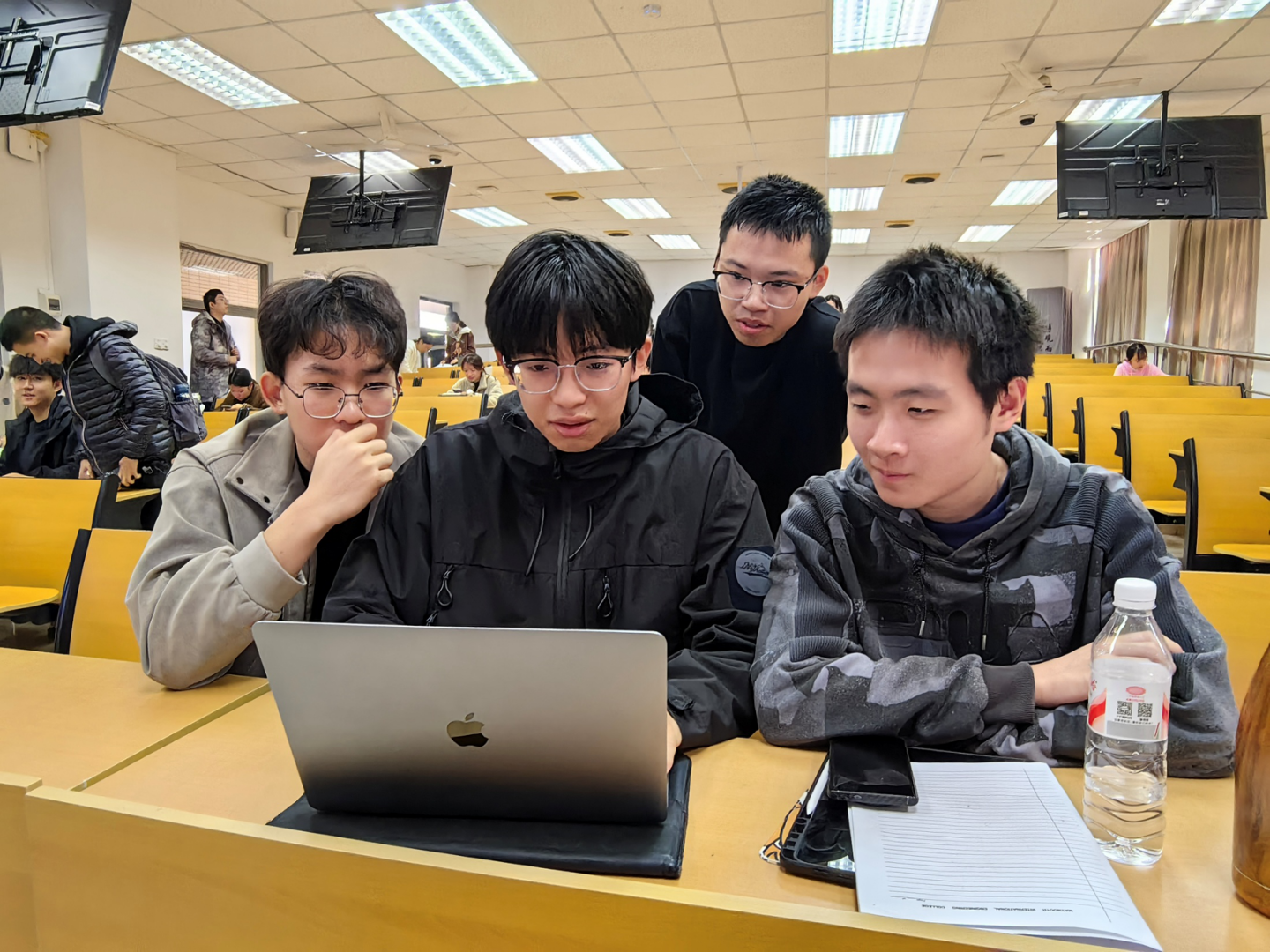
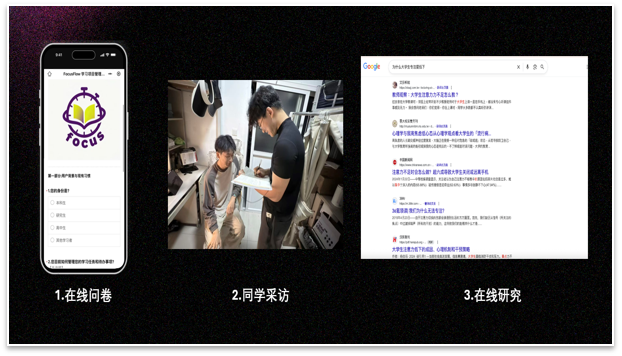
Throughout the development of FocusFlow, our team placed strong emphasis on teamwork and collaboration, which became a fundamental driver of the project’s overall progress and quality. By adopting an agile working approach, we were able to remain flexible, respond efficiently to evolving requirements, and continuously refine both our ideas and implementation. Regular stand-up meetings helped maintain alignment across the team, encouraged open communication, and created space to share challenges, exchange perspectives, and collectively explore solutions on time.
A clear division of responsibilities allowed each team member to contribute according to their strengths, which improved efficiency while also reinforcing a shared sense of accountability and ownership. This collaborative structure ensured that tasks progressed in parallel without losing coherence, and it strengthened trust within the team. At the same time, our consistent use of collaborative tools such as GitHub played a critical role in maintaining an organized workflow. Version control, frequent commits, and clear documentation made collaboration smoother and helped preserve code quality as the project evolved.
Beyond technical outcomes, this project reinforced the importance of effective communication, mutual respect, and shared goals. Working together on FocusFlow—an intelligent, integrated platform designed to support planning, deep work, and progress tracking—allowed us to grow not only in technical competence but also as a cohesive team. Overall, the experience demonstrated that strong collaboration enables teams to navigate complexity with confidence and deliver meaningful, user-centered solutions more effectively.
| Team/Role | Member(s) | Work Description | Contribution |
|---|---|---|---|
| Project Management | Jiayao Hu | Led requirement analysis, created the project schedule, coordinated between different teams, managed deliverables, and facilitated team meetings. | 10% |
| UI Design Team | Yuxiang Xie, Pengxiang Hu, Jianyuan Wu, Hongzhi He | Conducted user research, created wireframes, designed the high-fidelity interactive prototype in Figma, established the visual design system, and designed this project blog. | 31% (~7.75% each) |
| Backend Team | Hantao Wu, Zhihao Liu, Yitan Fang, Jiazhuo He, Shengpeng Yang, Chenhe Zhu | For this Prototype Phase: Defined the system architecture, created the data models and schemas for users, tasks, and grades, and specified the API endpoints required to support the frontend functionality. | 39% (~6.5% each) |
| Test Team | Feijie Zheng, Weixiang Zhou | Developed the test strategy, created test cases based on functional requirements, and conducted usability testing on the interactive prototype to identify UI/UX issues. | 20% (10% each) |
| Total | 13 Members | 100% |
Optimize the interaction of core modules: Improve the custom duration setting of focus mode, the smoothness of start/pause/reset/skip operation, and strengthen the countdown animation and sound reminder adaptation; optimize the interaction of label filtering and priority switching of task management to improve the convenience of operation.
Improve multi-scenario adaptation: deepen the responsive design for login, personal center, homepage check-in and other modules, and ensure that cell phone number/authentication code login, personal information modification and other functions are reasonably laid out and smoothly operated on multiple devices.
Upgrade data visualization: Based on the requirements of the report module, optimize the display effect of the daily/weekly/monthly learning statistics charts, support interactive operations (such as data filtering and details viewing), and improve the readability of data.
Landing personalized functions: customize the layout of the home page, display personalized greetings, and expand the fine configuration of theme switching functions to meet the UX requirements of multi-language support and theme personalization.
Build a strong security line: Strengthen the security of user authentication, improve the password hash storage and encrypted transmission mechanism of sensitive information, optimize the verification logic of CAPTCHA login, and prevent risks such as SQL injection.
Optimize data storage and query: optimize the database index and storage structure for core data such as task data, focus time statistics, check-in records, etc., and improve the query efficiency of task CRUD, continuous check-in days calculation, and learning data aggregation.
Improve data synchronization ability: local storage and cloud synchronization function of the landing report module ensures that learning data and task information are consistent at multiple ends, supports data import/export, and guarantees data security and reliability.
Enhance the scalability of the architecture: follow the project code specification (PEP8, ES6+), standardize the API interface design, and reserve expansion interfaces for the task labeling system and third-party course data docking to support the subsequent iteration of functions.
At this stage we completed alpha testing, the project was mostly functional and the few problems encountered had been resolved. Therefore, the project has completed internal testing, and in the next phase, we will focus on external user feedback to improve the project's functionality based on user feedback.


