社区
CGI
帖子详情
python apache windows8.1 64位配置error500
lunzi3775
2017-08-13 10:51:39
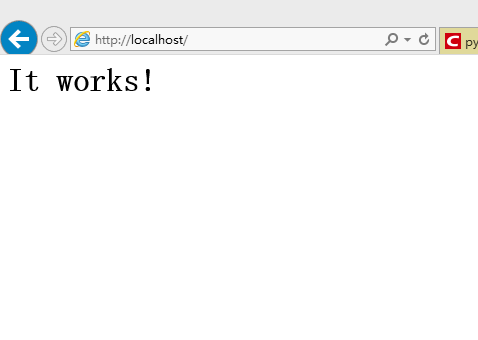
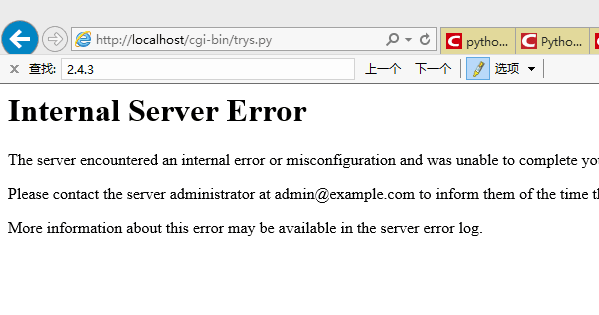
如图所示
...全文
564
1
打赏
收藏
python apache windows8.1 64位配置error500
如图所示
复制链接
扫一扫
分享
转发到动态
举报
写回复
配置赞助广告
用AI写文章
1 条
回复
切换为时间正序
请发表友善的回复…
发表回复
打赏红包
hongmei85
2017-08-13
打赏
举报
回复
http://blog.csdn.net/iamxiaoguizi/article/details/51484756
Python
for Bioinformatics 第二版,最新版
最新的讲授将
Python
用于生物信息编程的书籍,希望大家喜欢。目录如下: Conventions 4 1.2.2
Python
Versions 5 1.2.3 Code Style 5 1.2.4 Get the Most from This Book without Reading It All 6 1.2.5 Online Resources Related to This Book 7 1.3 WHY LEARN TO PROGRAM? 7 1.4 BASIC PROGRAMMING CONCEPTS 8 1.4.1 What Is a Program? 8 1.5 WHY
PYTHON
? 10 1.5.1 Main Features of
Python
10 1.5.2 Comparing
Python
with Other Languages 11 1.5.3 How Is It Used? 14 1.5.4 Who Uses
Python
? 15 1.5.5 Flavors of
Python
15 1.5.6 Special
Python
Distributions 16 1.6 ADDITIONAL RESOURCES 17 Chapter 2 First Steps with
Python
19 2.1 INSTALLING
PYTHON
20 2.1.1 Learn
Python
by Using It 20 2.1.2 Install
Python
Locally 20 2.1.3 Using
Python
Online 21 2.1.4 Testing
Python
22 2.1.5 First Use 22 2.2 INTERACTIVE MODE 23 2.2.1 Baby Steps 23 2.2.2 Basic Input and Output 23 2.2.3 More on the Interactive Mode 24 2.2.4 Mathematical Operations 26 2.2.5 Exit from the
Python
Shell 27 2.3 BATCH MODE 27 2.3.1 Comments 29 2.3.2 Indentation 30 2.4 CHOOSING AN EDITOR 32 2.4.1 Sublime Text 32 2.4.2 Atom 33 2.4.3 PyCharm 34 2.4.4 Spyder IDE 35 2.4.5 Final Words about Editors 36 2.5 OTHER TOOLS 36 2.6 ADDITIONAL RESOURCES 37 2.7 SELF-EVALUATION 37 Chapter 3 Basic Programming: Data Types 39 3.1 STRINGS 40 3.1.1 Strings Are Sequences of Unicode Characters 41 3.1.2 String Manipulation 42 3.1.3 Methods Associated with Strings 42 3.2 LISTS 44 3.2.1 Accessing List Elements 45 3.2.2 List with Multiple Repeated Items 45 3.2.3 List Comprehension 46 3.2.4 Modifying Lists 47 3.2.5 Copying a List 49 3.3 TUPLES 49 3.3.1 Tuples Are Immutable Lists 49 3.4 COMMON PROPERTIES OF THE SEQUENCES 51 3.5 DICTIONARIES 54 3.5.1 Mapping: Calling Each Value by a Name 54 3.5.2 Operating with Dictionaries 56 3.6 SETS 59 3.6.1 Unordered Collection of Objects 59 3.6.2 Set Operations 60 3.6.3 Shared Operations with Other Data Types 62 3.6.4 Immutable Set: Frozenset 63 3.7 NAMING OBJECTS 63 3.8 ASSIGNING A VALUE TO A VARIABLE VERSUS BINDING A NAME TO AN OBJECT 64 3.9 ADDITIONAL RESOURCES 67 3.10 SELF-EVALUATION 68 Chapter 4 Programming: Flow Control 69 4.1 IF-ELSE 69 4.1.1 Pass Statement 74 4.2 FOR LOOP 75 4.3 WHILE LOOP 77 4.4 BREAK: BREAKING THE LOOP 78 4.5 WRAPPING IT UP 80 4.5.1 Estimate the Net Charge of a Protein 80 4.5.2 Search for a Low-Degeneration Zone 81 4.6 ADDITIONAL RESOURCES 83 4.7 SELF-EVALUATION 83 Chapter 5 Handling Files 85 5.1 READING FILES 86 5.1.1 Example of File Handling 87 5.2 WRITING FILES 89 5.2.1 File Reading and Writing Examples 90 5.3 CSV FILES 90 5.4 PICKLE: STORING AND RETRIEVING THE CONTENTS OF VARI- ABLES 94 5.5 JSON FILES 96 5.6 FILE HANDLING: OS, OS.PATH, SHUTIL, AND PATH.PY MODULE 98 5.6.1 path.py Module 100 5.6.2 Consolidate Multiple DNA Sequences into One FASTA File 102 5.7 ADDITIONAL RESOURCES 102 5.8 SELF-EVALUATION 103 Chapter 6 Code Modularizing 105 6.1 INTRODUCTION TO CODE MODULARIZING 105 6.2 FUNCTIONS 106 6.2.1 Standard Way to Make
Python
Code Modular 106 6.2.2 Function Parameter Options 110 6.2.3 Generators 113 6.3 MODULES AND PACKAGES 114 6.3.1 Using Modules 115 6.3.2 Packages 116 6.3.3 Installing Third-Party Modules 117 6.3.4 Virtualenv: Isolated
Python
Environments 119 6.3.5 Conda: Anaconda Virtual Environment 121 6.3.6 Creating Modules 124 6.3.7 Testing Modules 125 6.4 ADDITIONAL RESOURCES 127 6.5 SELF-EVALUATION 128 Chapter 7
Error
Handling 129 7.1 INTRODUCTION TO
ERROR
HANDLING 129 7.1.1 Try and Except 131 7.1.2 Exception Types 134 7.1.3 Triggering Exceptions 135 7.2 CREATING CUSTOMIZED EXCEPTIONS 136 7.3 ADDITIONAL RESOURCES 137 7.4 SELF-EVALUATION 138 Chapter 8 Introduction to Object Orienting Programming (OOP) 139
8.1
OBJECT PARADIGM AND
PYTHON
139 8.2 EXPLORING THE JARGON 140 8.3 CREATING CLASSES 142 8.4 INHERITANCE 145 8.5 SPECIAL METHODS 149 8.5.1 Create a New Data Type Using a Built-in Data Type 154 8.6 MAKING OUR CODE PRIVATE 154 8.7 ADDITIONAL RESOURCES 155 8.8 SELF-EVALUATION 156 Chapter 9 Introduction to Bio
python
157 9.1 WHAT IS BIO
PYTHON
? 158 9.1.1 Project Organization 158 9.2 INSTALLING BIO
PYTHON
159 9.3 BIO
PYTHON
COMPONENTS 162 9.3.1 Alphabet 162 9.3.2 Seq 163 9.3.3 MutableSeq 165 9.3.4 SeqRecord 166 9.3.5 Align 167 9.3.6 AlignIO 169 9.3.7 ClustalW 171 9.3.8 SeqIO 173 9.3.9 AlignIO 176 9.3.10 BLAST 177 9.3.11 Biological Related Data 187 9.3.12 Entrez 190 9.3.13 PDB 194 9.3.14 PROSITE 196 9.3.15 Restriction 197 9.3.16 SeqUtils 200 9.3.17 Sequencing 202 9.3.18 SwissProt 205 9.4 CONCLUSION 207 9.5 ADDITIONAL RESOURCES 207 9.6 SELF-EVALUATION 209 Section II Advanced Topics Chapter 10 Web Applications 213 10.1 INTRODUCTION TO
PYTHON
ON THE WEB 213 10.2 CGI IN
PYTHON
214 10.2.1 Configuring a Web Server for CGI 215 10.2.2 Testing the Server with Our Script 215 10.2.3 Web Program to Calculate the Net Charge of a Protein (CGI version) 219 10.3 WSGI 221 10.3.1 Bottle: A
Python
Web Framework for WSGI 222 10.3.2 Installing Bottle 223 10.3.3 Minimal Bottle Application 223 10.3.4 Bottle Components 224 10.3.5 Web Program to Calculate the Net Charge of a Protein (Bottle Version) 229 10.3.6 Installing a WSGI Program in
Apache
232 10.4 ALTERNATIVE OPTIONS FOR MAKING
PYTHON
-BASED DYNAMIC WEB SITES 232 10.5 SOME WORDS ABOUT SCRIPT SECURITY 232 10.6 WHERE TO HOST
PYTHON
PROGRAMS 234 10.7 ADDITIONAL RESOURCES 235 10.8 SELF-EVALUATION 236 Chapter 11 XML 237 11.1 INTRODUCTION TO XML 237 11.2 STRUCTURE OF AN XML DOCUMENT 241 11.3 METHODS TO ACCESS DATA INSIDE AN XML DOCUMENT 246 11.3.1 SAX: cElementTree Iterparse 246 11.4 SUMMARY 251 11.5 ADDITIONAL RESOURCES 252 11.6 SELF-EVALUATION 252 Chapter 12
Python
and Databases 255 12.1 INTRODUCTION TO DATABASES 256 12.1.1 Database Management: RDBMS 257 12.1.2 Components of a Relational Database 258 12.1.3 Database Data Types 260 12.2 CONNECTING TO A DATABASE 261 12.3 CREATING A MYSQL DATABASE 262 12.3.1 Creating Tables 263 12.3.2 Loading a Table 264 12.4 PLANNING AHEAD 266 12.4.1
Python
U: Sample Database 266 12.5 SELECT: QUERYING A DATABASE 269 12.5.1 Building a Query 271 12.5.2 Updating a Database 273 12.5.3 Deleting a Record from a Database 273 12.6 ACCESSING A DATABASE FROM
PYTHON
274 12.6.1 PyMySQL Module 274 12.6.2 Establishing the Connection 274 12.6.3 Executing the Query from
Python
275 12.7 SQLITE 276 12.8 NOSQL DATABASES: MONGODB 278 12.
8.1
Using MongoDB with PyMongo 278 12.9 ADDITIONAL RESOURCES 282 12.10 SELF-EVALUATION 284 Chapter 13 Regular Expressions 285 13.1 INTRODUCTION TO REGULAR EXPRESSIONS (REGEX) 285 13.1.1 REGEX Syntax 286 13.2 THE RE MODULE 287 13.2.1 Compiling a Pattern 290 13.2.2 REGEX Examples 292 13.2.3 Pattern Replace 294 13.3 REGEX IN BIOINFORMATICS 294 13.3.1 Cleaning Up a Sequence 296 13.4 ADDITIONAL RESOURCES 297 13.5 SELF-EVALUATION 298 Chapter 14 Graphics in
Python
299 14.1 INTRODUCTION TO BOKEH 299 14.2 INSTALLING BOKEH 299 14.3 USING BOKEH 301 14.3.1 A Simple X-Y Plot 303 14.3.2 Two Data Series Plot 304 14.3.3 A Scatter Plot 306 14.3.4 A Heatmap 308 14.3.5 A Chord Diagram 309 Section III
Python
Recipes with Commented Source Code Chapter 15 Sequence Manipulation in Batch 315 15.1 PROBLEM DESCRIPTION 315 15.2 PROBLEM ONE: CREATE A FASTA FILE WITH RANDOM SE- QUENCES 315 15.2.1 Commented Source Code 315 15.3 PROBLEM TWO: FILTER NOT EMPTY SEQUENCES FROM A FASTA FILE 316 15.3.1 Commented Source Code 317 15.4 PROBLEM THREE: MODIFY EVERY RECORD OF A FASTA FILE 319 15.4.1 Commented Source Code 320 Chapter 16 Web Application for Filtering Vector Contamination 321 16.1 PROBLEM DESCRIPTION 321 16.1.1 Commented Source Code 322 16.2 ADDITIONAL RESOURCES 326 Chapter 17 Searching for PCR Primers Using Primer3 329 17.1 PROBLEM DESCRIPTION 329 17.2 PRIMER DESIGN FLANKING A VARIABLE LENGTH REGION 330 17.2.1 Commented Source Code 331 17.3 PRIMER DESIGN FLANKING A VARIABLE LENGTH REGION, WITH BIO
PYTHON
332 17.4 ADDITIONAL RESOURCES 333 Chapter 18 Calculating Melting Temperature from a Set of Primers 335 1
8.1
PROBLEM DESCRIPTION 335 1
8.1
.1 Commented Source Code 336 18.2 ADDITIONAL RESOURCES 336 Chapter 19 Filtering Out Specific Fields from a GenBank File 339 19.1 EXTRACTING SELECTED PROTEIN SEQUENCES 339 19.1.1 Commented Source Code 339 19.2 EXTRACTING THE UPSTREAM REGION OF SELECTED PRO- TEINS 340 19.2.1 Commented Source Code 340 19.3 ADDITIONAL RESOURCES 341 Chapter 20 Inferring Splicing Sites 343 20.1 PROBLEM DESCRIPTION 343 20.1.1 Infer Splicing Sites with Commented Source Code 345 20.1.2 Sample Run of Estimate Intron Program 347 Chapter 21 Web Server for Multiple Alignment 349 21.1 PROBLEM DESCRIPTION 349 21.1.1 Web Interface: Front-End. HTML Code 349 21.1.2 Web Interface: Server-Side Script. Commented Source Code 351 21.2 ADDITIONAL RESOURCES 353 Chapter 22 Drawing Marker Positions Using Data Stored in a Database 355 22.1 PROBLEM DESCRIPTION 355 22.1.1 Preliminary Work on the Data 355 22.1.2 MongoDB Version with Commented Source Code 358 Section IV Appendices
Python
Cookbook, 2nd Edition
• Table of Contents • Index • Reviews • Reader Reviews • Errata • Academic
Python
Cookbook, 2nd Edition By David Ascher, Alex Martelli, Anna Ravenscroft Publisher : O'Reilly Pub Date : March 2005 ISBN : 0-596-00797-3 Pages : 844 Copyright Preface The Design of the Book The Implementation of the Book Using the Code from This Book Audience Organization Further Reading Conventions Used in This Book How to Contact Us Safari® Enabled Acknowledgments Chapter 1. Text Introduction Recipe 1.1. Processing a String One Character at a Time Recipe 1.2. Converting Between Characters and Numeric Codes Recipe 1.3. Testing Whether an Object Is String-like Recipe 1.4. Aligning Strings Recipe 1.5. Trimming Space from the Ends of a String Recipe 1.6. Combining Strings Recipe 1.7. Reversing a String by Words or Characters Recipe 1.8. Checking Whether a String Contains a Set of Characters Recipe 1.9. Simplifying Usage of Strings' translate Method Recipe 1.10. Filtering a String for a Set of Characters Recipe 1.11. Checking Whether a String Is Text or Binary Recipe 1.12. Controlling Case Recipe 1.13. Accessing Substrings Recipe 1.14. Changing the Indentation of a Multiline String Recipe 1.15. Expanding and Compressing Tabs Recipe 1.16. Interpolating Variables in a String Recipe 1.17. Interpolating Variables in a Stringin
Python
2.4 Recipe 1.18. Replacing Multiple Patterns in a Single Pass Recipe 1.19. Checking a String for Any of Multiple Endings Recipe 1.20. Handling International Text with Unicode Recipe 1.21. Converting Between Unicode and Plain Strings Recipe 1.22. Printing Unicode Charactersto Standard Output
Windows
平台
Apache
HTTPD服务器部署与
配置
实战
Apache
HTTP Server(简称
Apache
)是全球最流行的开源Web服务器软件之一,以其高稳定性、模块化设计和跨平台支持著称。在
Windows
环境下,
Apache
虽非原生服务,但通过官方及第三方维护的Win64移植版本(如
Apache
Lounge提供的httpd-2.4.x-win64-VS17),实现了良好的运行表现与开发兼容性。
Windows
版
Apache
以独立进程方式运行,依赖Visual C++ Redistributable运行库,并支持注册为系统服务,便于长期驻留与管理。
Apache
服务的搭建与
配置
(超详细版)
Apache
是一种常见的Web服务器软件,广泛用于Linux和其他UNIX操作系统上。它是自由软件,可以通过开放源代码的方式进行自由分发和修改。
Apache
提供了处理静态和动态内容的能力,而且还支持多种编程语言和脚本,如PHP、
Python
和Perl。此外,
Apache
还支持SSL、TLS和虚拟主机等功能,可以很好地满足大量的Web应用程序的需求。
CentOS 下
Apache
服务器的安装与
配置
本文旨在为系统管理员和开发者提供一套完整的 CentOS 环境下
Apache
服务器部署方案。
Apache
核心组件安装与服务管理主
配置
文件httpd.conf深度解析虚拟主机(基于域名/IP)
配置
实战HTTPS 加密(Let’s Encrypt 免费证书)部署性能优化参数调优(并发连接、缓存策略)安全加固最佳实践(防火墙、访问控制、日志审计)基础环境准备:系统版本要求、依赖组件检查核心安装流程:通过 YUM 安装
Apache
及扩展模块
配置
文件解析。
CGI
2,203
社区成员
4,518
社区内容
发帖
与我相关
我的任务
CGI
Web 开发 CGI
复制链接
扫一扫
分享
社区描述
Web 开发 CGI
社区管理员
加入社区
获取链接或二维码
近7日
近30日
至今
加载中
查看更多榜单
社区公告
暂无公告
试试用AI创作助手写篇文章吧
+ 用AI写文章



 发帖
发帖 与我相关
与我相关 我的任务
我的任务
 分享
分享
