


183
社区成员
 发帖
发帖 与我相关
与我相关 我的任务
我的任务
 分享
分享|
The Link Your Class | |
|
The Link of Requirement of This Assignment | https://bbs.csdn.net/topics/603737050 |
|
The Aim of This Assignment |
Software Testing |
|
MU STU ID and FZU STU ID |
19104529_831901217 |
This experiment is used to record the test process, summarize the test conditions of each round, and analyze the test data. Here, I use Python for convenience, so unittest task is my choice.
import unittest, random


# Test Class
class MyClass(object):
    @classmethod
    def sum(self, a, b):
        return a + b
    @classmethod
    def div(self, a, b):
        return a / b
    @classmethod
    def retrun_None(self):
        return None


# Unit Test Class
class MyTest(unittest.TestCase):
    # assertEqual()
    def test_assertEqual(self):
        # test if a+b equals sum or not
        try:
            a, b = 1, 2
            sum = 3
            self.assertEqual(a + b, sum, 'assert failed!,%s + %s != %s' % (a, b, sum))
        except AssertionError as e:
                print(e)

        # assertNotEqual()
    def test_assertNotEqual(self):
        # fix missing three lines of codes below ‘try’, test if b-a equals res or not
        try:
            a,b = 1, 2
            res = 1
            # Using assertNotEqual() to prove 2-1=1
            self.assertNotEqual(b-a,res,'assert true!,%s - %s == %s' %(b, a, res))
        except AssertionError as e:
            print(e)

    # assertTrue()
    def test_assertTrue(self):

        try:
            self.assertTrue(1 == 1, "False expression")
        except AssertionError as e:
            print(e)

    # assertFalse()
    def test_assertFalse(self):
        # fix missing codes below ‘try’, only a line of codes needed
        try:
            # Using assertFalse() to prove 1==1 reversely
            self.assertFalse(1 != 1, "True expression")
        except AssertionError as e:
            print(e)

        # assertIs()
    def test_assertIs(self):
        # test a and b are totally same
        try:
            a = 12
            b = a
            self.assertIs(a, b, "%s and %s are not same" % (a, b))
        except AssertionError as e:
            print(e)

        # assertIsInstance()
    def test_assertIsInstance(self):
        # fix missing codes below ‘y=object’ to test type(x) != y, only a line of codes needed
        try:
            x = MyClass
            y = object
            # Using assertIs() to prove obj is not same
            self.assertIs(x, y, "type(%s) and %s are not same" % (x, y))
        except AssertionError as e:
            print(e)

    if __name__ == '__main__':
        # run unittest
        unittest.main()
Thus the result is: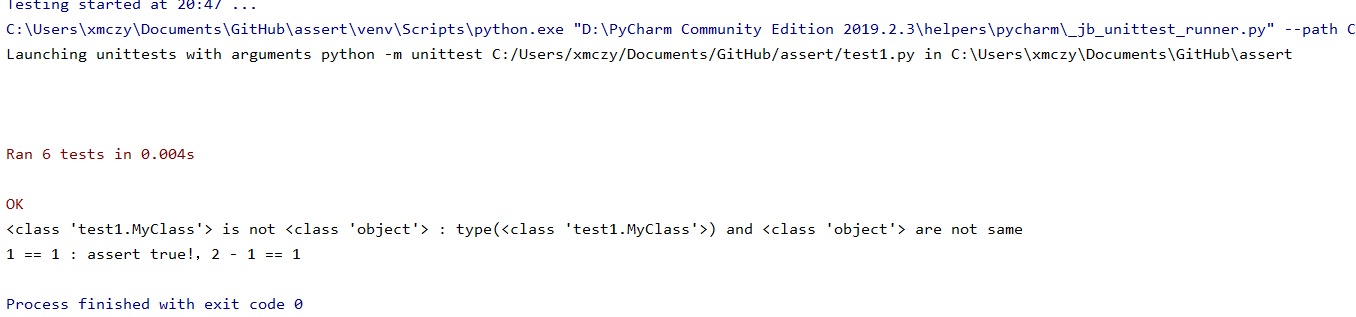
2.unittest test groups
class Calc(object):

    def add(self, *d):
        #
        result = 0
        for i in d:
            result += i
        return result

    def mul(self, *d):
        #
        result = 1
        for i in d:
            result = result * i
        return result


    def sub(self, a, *d):
    #
        result = a
        for i in d:
            result = result - i
        return result


    def div(self, a, *d):
    #
        result = a
        for i in d:
            result = result / i
        return result


import unittest
import random
from Calc import Calc


class TestCalcFunctions(unittest.TestCase):

    def setUp(self):
        self.c = Calc()
        print("setup completed!")

    def test_sum(self):
        self.assertTrue(self.c.add(1, 2, 3, 4) == 10)


    def test_sub(self):
        # fix a line of codes to test c.sub(self, a, *b) method
        # Using assertFalse() to prove the -8 !=10
        self.assertFalse(self.c.sub(1, 2, 3, 4) == 10)

    def test_mul(self):
        # fix a line of codes to test c.mul(self, *b) method
        # Using assertTrue() to prove the 24 ==24
        self.assertTrue(self.c.mul(2, 3, 4) == 24)

    def test_div(self):
        # fix a line of codes to test c.div(self, a, *b) method
        # Using assertFalse() to prove the 1/24 !=10
        self.assertFalse(self.c.div(1, 2, 3, 4) == 10)

    def test(self):
        print("test completed!")

    def tearDown(self):
        print("tearDown completed")


if __name__ == '__main__':
    unittest.main()


import random
import unittest
from TestCalc import TestCalcFunctions


class TestSequenceFunctions(unittest.TestCase):
    def setUp(self):
        self.seq = list(range(10))

    def tearDown(self):
        pass

    def test_choice(self):
        # chose an element from seq randomly
        element = random.choice(self.seq)
        # check element is truly in the sequence
        self.assertTrue(element in self.seq)

    def test_sample(self):
        # if codes raise exception
        with self.assertRaises(ValueError):
            random.sample(self.seq, 20)

        for element in random.sample(self.seq, 5):
            self.assertTrue(element in self.seq)


class TestDictValueFormatFunctions(unittest.TestCase):
    def setUp(self):
        self.seq = list(range(10))

    def tearDown(self):
        pass

    def test_shuffle(self):
        # shuffle sequence
        random.shuffle(self.seq)
        self.seq.sort()
        self.assertEqual(self.seq, list(range(10)))
        # check TypeError exception
        self.assertRaises(TypeError, random.shuffle, (1, 2, 3))


if __name__ == '__main__':
    # get all test methods start with ‘test’ and return a suite
    suite1 = unittest.TestLoader().loadTestsFromTestCase(TestSequenceFunctions)
    suite2 = unittest.TestLoader().loadTestsFromTestCase(TestCalcFunctions)
    suite3 = unittest.TestLoader().loadTestsFromTestCase(TestDictValueFormatFunctions)
    # please fix another two suite, suite2 of TestCalcFunctions and suite3 of TestDictValueFormatFunctions

    # put more test class into suite
    # you can change suites’ order, like [suite1, suite2, suite3]
    suite = unittest.TestSuite([suite2, suite1, suite3])
    # set verbosity = 2 you could get more detailed information
    unittest.TextTestRunner(verbosity=2).run(suite)
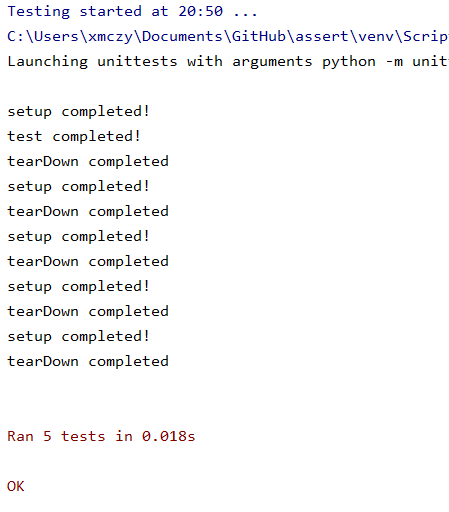
Thus, the result is:
3. unittest skip test
# encoding=utf-8

import random, sys, unittest


class TestSeqFunctions(unittest.TestCase):
    a = 1
    def setUp(self):
        self.seq = list(range(20))

    @unittest.skip("skipping")  # skip this method anyway
    def test_shuffle(self):
        random.shuffle(self.seq)
        self.seq.sort()
        self.assertEqual(self.seq, list(range(20)))
        self.assertRaises(TypeError, random.shuffle, (1, 2, 3))

    # add a line of annotation thatskip this method if a>5
    # Using skipif() If the condition is true, continue to execute, otherwise skip the decorated test case;
    @unittest.skipIf(a>5, "skipping if a>5")
    def test_choice(self):
        element = random.choice(self.seq)
        self.assertTrue(element in self.seq)

    # add a line of annotation that skip if not in linux platform
    # Using skipif() If the condition is true, continue to execute, otherwise skip the decorated test case;
    # Using sys.platform to generate the platform information
    @unittest.skipIf(sys.platform != "linux*", "skipping if not in linux platform")
    def test_sample(self):
        with self.assertRaises(ValueError):
            random.sample(self.seq, 20)
        for element in random.sample(self.seq, 5):
            self.assertTrue(element in self.seq)


if __name__ == "__main__":
    # unittest.main()
    suite = unittest.TestLoader().loadTestsFromTestCase(TestSeqFunctions)
    suite = unittest.TestSuite(suite)
    unittest.TextTestRunner(verbosity=2).run(suite)
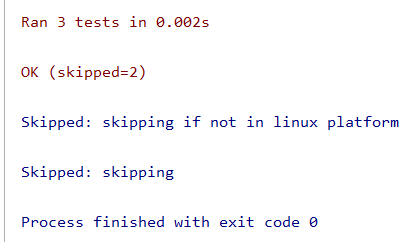
Thus, the result is:
4.unittest Run test under numerical order or alpha order
# encoding=utf-8

import unittest
from Calc import Calc
class MyTest(unittest.TestCase):
    @classmethod
    def setUpClass(self):
        print("init Calc before unittest")
        self.c = Calc()
    # Using the test_(number) to sort program from large to small
    def test_1add(self):
        print("run add()")
        self.assertEqual(self.c.add(1, 2, 12), 15, 'test add fail')

    def test_2sub(self):
        print("run sub()")
        self.assertEqual(self.c.sub(2, 1, 3), -2, 'test sub fail')

    def test_3mul(self):
        print("run mul()")
        self.assertEqual(Calc.mul(1,2, 3, 5), 30, 'test mul fail')

    def test_4div(self):
        print("run div()")
        self.assertEqual(Calc.div(1,8, 2, 4), 1, 'test div fail')

if __name__ == '__main__':
    unittest.main()
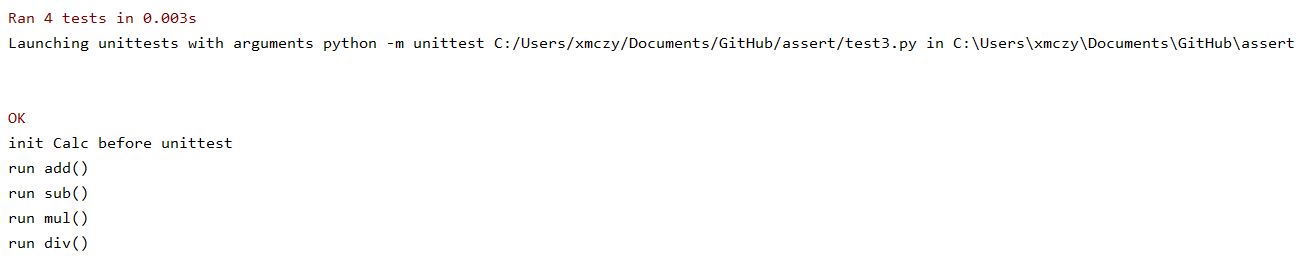
Thus, the result is:
5.unittest Time Test
import time
import unittest
import timeout_decorator


class timeoutTest(unittest.TestCase):

    # set a time decorator(annotation) which will be triggered after 5s’ running
    # Using the decorator library to stop 5 seconds
    @timeout_decorator.timeout(5)
    def testtimeout(self):
        print("Start")

    for i in range(1, 10):
        time.sleep(1)
        print("%d seconds have passed" % i)


if __name__ == "__main__":
    unittest.main()
Thus, the result is:
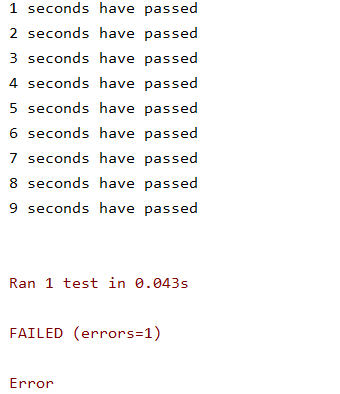
For the error that occurs, is because the Limitations of the code library as well as the limitions of the Time overflow
After several rounds of testing in Python, we have been basically familiar with the basic functions in unittest library and other related libraries, applied them systematically, preliminarily completed the experimental requirements, and left some remaining problems to be further studied

