2601_FZU-MU_SE

Fubangbang_Group2_Assignment3: Requirement Analysis
 墨衍会员 · AI 创作全网分发 墨衍智能分发 通过墨衍一键同步至各平台 可同步平台 CSDN微信公众号微博知乎掘金百家号博客园抖音小红书 你的文章也可以这样分发 墨衍会员 ¥399起/年,写一次发全网
我也要 关注 + 加入社区
Fubangbang Requirements Analysis Project Blog
Assignment 3 — Group 2
Project: Fubangbang — Campus Resource Sharing Platform
| Item | Details |
|---|---|
| Course | EE308 |
| Course Community | 2601_FZU-MU_SE |
| Assignment Requirement | Third Assignment — Requirement Analysis |
| Team Name | Fubangbang (福帮帮) |
| Assignment Goal | Complete requirements analysis, improve the Software Requirements Specification (SRS), prepare the domain class diagram and interface prototype, and organize the presentation materials. |
| Other References | Previous Group 2 Blog; Backend Repository; Frontend Repository |
Table of Contents
- 1. Team Division of Labor
- 2. Software Requirements Specification
- 3. Team Organization and Schedule
- 4. Team Collaboration
- 5. Key Challenges and Countermeasures
- 6. Deliverables and Links
1. Team Division of Labor
Group 2 consists of 14 members organized into four teams: the Backend Team, Frontend Team, UI and Presentation Team, and Execution Support Team. A cross-team documentation role coordinates the project blog, Software Requirements Specification (SRS), and domain class diagram with the development work.
1.1 Team Structure and Responsibilities
| Team | Leader | Members | Main Responsibilities |
|---|---|---|---|
| Backend Team | Chen Haoyang | Chen Jiayuan; Chen Junjie | Backend development, repository management, API implementation, technical coordination, business-logic review, and data-model checks. |
| Frontend Team | Zhu Zhaoyang | Zhou Qican; Zhu Mingqian | Frontend coordination, page and component development, interaction implementation, prototype refinement, presentation preparation, and classroom reporting. |
| UI and Presentation Team | Ye Jiahui | Zhang Sufang; Chen Zhijun; Wu Sifan | UI design, interface layout, visual refinement, interaction review, frontend collaboration, and presentation support. |
| Execution Support Team | Chen Mohan | Chen Wei; Zeng Wenhan; Zheng Bowei | Task follow-up, issue recording, document formatting, screenshot organization, deliverable checks, and submission preparation. |
1.2 Requirements Documentation and Class Diagram
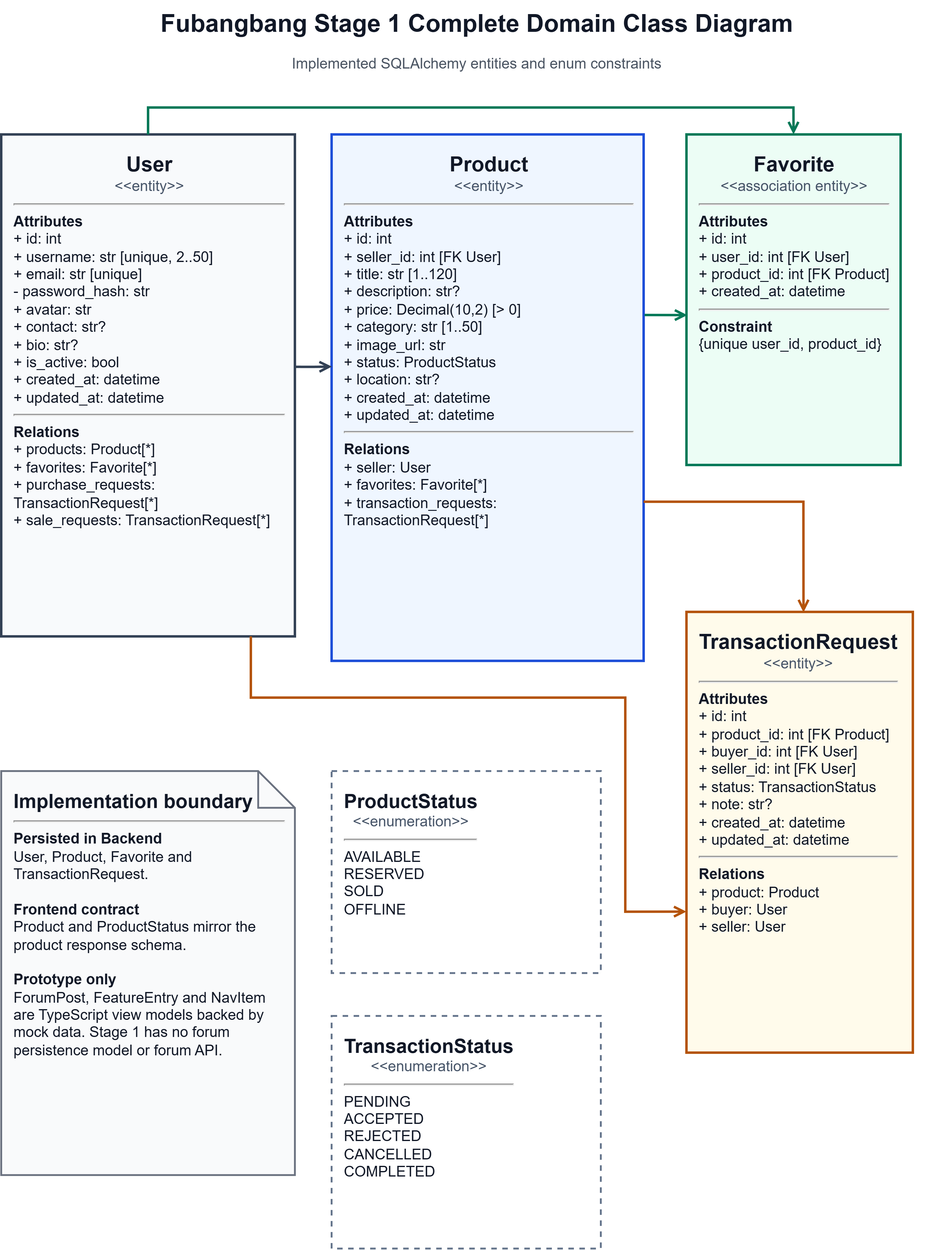
Chen Jiayuan is primarily responsible for the main project blog, the Software Requirements Specification (SRS), and the domain class diagram. This role includes organizing the requirements analysis, documenting system functions and constraints, preparing the class diagram, and integrating the project documentation.
Coordination with the backend, frontend, and UI teams helps keep the documents consistent with the intended system design and current development status. The documentation role also checks that the SRS, class diagram, interface prototype, and implementation describe the same system scope.
1.3 Member Workload and Contribution
The following contribution percentages apply specifically to this requirements analysis assignment, rather than to the overall software project. They reflect the team's allocation of work for this assignment.
| Student ID | Task Description | Contribution |
|---|---|---|
| 832402203 / 24125415 | Chen Jiayuan — Main project blog, SRS drafting, domain class diagram, and documentation integration. | 18% |
| 832402202 / 24125407 | Chen Haoyang — Backend development, repository management, API implementation, and technical coordination. | 18% |
| 832402204 / 24127540 | Chen Junjie — Backend technical support, business-logic review, and data-model checks. | 4% |
| 832402229 / 24125920 | Zhu Zhaoyang — Frontend coordination, presentation preparation, and classroom reporting. | 12% |
| 832402228 / 24125911 | Zhou Qican — Frontend page development, interaction implementation, and prototype refinement. | 7% |
| 832402230 / 24127591 | Zhu Mingqian — Frontend components, page interactions, and implementation support. | 7% |
| 832402225 / 24125474 | Ye Jiahui — UI design, frontend collaboration, prototype refinement, and visual consistency. | 18% |
| 832402226 / 24126519 | Zhang Sufang — Interface visual design, page layout, and visual refinement. | 4% |
| 832402207 / 24127248 | Chen Zhijun — Interface refinement, interaction review, and presentation support. | 4% |
| 832402222 / 24126420 | Wu Sifan — Supporting documentation, document review, and presentation materials. | 4% |
| 832402205 / 24126446 | Chen Mohan — Execution support coordination and task follow-up. | 1% |
| 832402206 / 24126713 | Chen Wei — Supporting checks and issue recording. | 1% |
| 832402201 / 24127183 | Zeng Wenhan — Document formatting and screenshot organization. | 1% |
| 832302218 / 23124377 | Zheng Bowei — Document checks and submission preparation. | 1% |
| — | Total | 100% |
The contribution percentages shown above sum to 100%. They describe the workload for this assignment only and should not be interpreted as the members' contributions to the entire software project.
2. Software Requirements Specification
2.1 Project Overview
Fubangbang is a campus-oriented web application designed for second-hand resource exchange and campus information sharing among students of Fuzhou University.
The project focuses on two main areas: campus second-hand trading and campus information sharing. Students can browse and publish second-hand items and access useful campus information through the platform. The interface prototype also presents campus forum and related information-sharing interactions.
The goal is to provide students with a convenient platform for finding campus resources, sharing useful information, and improving everyday campus life.
2.2 Technical and Implementation Baseline
The project uses a separated frontend and backend architecture.
Frontend: Vue 3, TypeScript, Vue Router, and Vite.
Backend: FastAPI, SQLAlchemy 2, and Pydantic.
The current backend provides a foundation for user authentication, profile management, product management, favorites, and transaction requests. The initial frontend and backend frameworks have been prepared, but frontend-backend integration has not yet been completed.
| Area | Current Status |
|---|---|
| Requirements and design preparation | Initial requirements analysis, SRS, domain class diagram, and interface prototype have been prepared. |
| Initial development frameworks | The frontend and backend frameworks have been established. |
| Current development priority | Align the frontend with supported backend APIs and verify the main workflows. |
| Frontend-backend integration | Integration remains to be completed. |
| Prototype-level scope | Some campus forum and guide-sharing interactions still require further development and integration. |
2.3 SRS Content and Scope Control
The SRS organizes the project requirements through an introduction, overall system description, user scenarios, domain class diagram, interface prototypes, functional descriptions, and acceptance and verification criteria.
The document focuses on the actual requirements of Fubangbang and distinguishes intended functionality from features that have not yet been fully implemented or integrated. This prevents prototype interactions from being presented as completed backend functionality.
The SRS, class diagram, interface prototype, and source code must remain consistent as development continues. Important changes to requirements or implementation should be reviewed and reflected in the relevant documents.
The complete SRS document is linked in Section 6.
2.4 SRS Checklist
Before submitting the SRS, the team checks whether the required sections are present and consistent with the project design and implementation. The checklist below records the current document scope and the final checks that should be performed.
| Checklist Item | Current Status | Review Focus |
|---|---|---|
| Introduction | Included in the current SRS | Confirm that the purpose, background, and scope accurately describe Fubangbang. |
| User Scenarios | Included in the current SRS | Check that user roles and scenarios match the intended system functions. |
| Class Diagrams | Included in the current SRS | Check that entities, attributes, and relationships are consistent with the current domain model and backend design. |
| Interface Prototypes | Included in the current SRS | Confirm that the prototype illustrations correspond to the described pages and interactions. |
| Functional Descriptions | Included in the current SRS | Distinguish implemented functions from prototype-only or planned functionality. |
| Acceptance and Verification Criteria | Included in the current SRS | Ensure that the stated criteria can be checked through observable behavior or testing. |
| Figures and Tables | Final consistency review required | Check numbering, captions, readability, and consistency with the surrounding text. |
| Text Formatting | Final formatting review required | Check headings, fonts, font sizes, line spacing, paragraph spacing, and table layout. |
| Overall Document Style | Final consistency review required | Keep terminology, abbreviations, graphical symbols, and visual style consistent throughout the document. |
| National Standard and References | Verify against the final SRS | Confirm that the applicable national standard and references actually used are identified in the document. Do not claim full compliance without checking the document against the cited standard. |
This checklist is intended to support the final review rather than to replace the SRS itself. Any incomplete item should be corrected or clearly identified before submission.
3. Team Organization and Schedule
3.1 Project Schedule and Milestones
The project is planned to run from September 30 to December 14, 2026. The following milestones describe the team's roadmap and are subject to adjustment according to actual development progress.
| Milestone | Period | Main Tasks | Expected Deliverables | Status |
|---|---|---|---|---|
| M1: Project Initiation | Sep. 30 – Oct. 12 | Confirm the project direction, team organization, and initial scope. | Project plan and initial requirements. | Completed |
| M2: Requirements Analysis and Prototype Design | Oct. 13 – Oct. 19 | Complete requirements analysis, SRS, domain class diagram, interface prototype, and presentation preparation. | SRS, class diagram, interface prototype, and presentation materials. | Deliverables prepared; final consistency review remains. |
| M3: System Design and API Alignment | Oct. 20 – Nov. 2 | Refine the system design, clarify data models, and define API contracts. | Refined design, API agreements, and an agreed integration plan. | Initial frameworks prepared; API alignment remains. |
| M4: Core Development and Initial Integration | Nov. 2 – Nov. 16 | Develop priority functions and begin connecting the frontend to supported backend APIs. | Initial integrated workflows for core functions. | Planned |
| M5: Integration and Testing | Nov. 17 – Nov. 30 | Improve integration, test the main workflows, and fix important defects. | Integrated demonstration version and a record of remaining issues. | Planned |
| M6: Final Improvement and Delivery | Dec. 1 – Dec. 14 | Improve system stability, complete project documentation, and prepare the final demonstration. | Final system version, project documents, and presentation materials. | Planned |
3.2 Progress Tracking
The team tracks progress against the project milestones and monitors the completion of expected deliverables. The current priority is to align the frontend with the supported backend APIs and verify the main workflows.
Prototype-only functions will remain separate from functions that have been implemented and tested. Unresolved issues will be recorded, and task priorities will be adjusted when necessary.
The team aims to complete and verify the core workflows before expanding optional features, while preparing the final deliverables before December 14, 2026.
4. Team Collaboration
The team uses a four-team structure to allocate responsibilities while coordinating requirements, design, implementation, and presentation materials across different roles.
| Collaboration Area | Current Approach |
|---|---|
| Task allocation | Team leaders coordinate work within the backend, frontend, UI and presentation, and execution support teams. The documentation role works across these teams. |
| Progress synchronization | Progress is reviewed against the project milestones, and expected deliverables are tracked. |
| Document collaboration | The project blog, SRS, class diagram, interface prototype, and presentation materials are reviewed for consistency with the intended system design and current implementation status. |
| Communication | Team members coordinate questions and share updates through the group's established communication channels. Relevant team members discuss changes that affect requirements, design, or implementation. |
| Technical coordination | The frontend and backend teams clarify API requests, data formats, authentication, data models, and API contracts before integration. |
| Issue tracking and review | Unresolved issues are recorded, task adjustments are coordinated when necessary, and integrated workflows are tested before they are considered complete. |
This collaboration structure helps reduce misunderstandings between teams and supports consistency between the requirements, interface design, class diagram, and implementation.
5. Key Challenges and Countermeasures
5.1 Key Challenges
5.1.1 Frontend and Backend Integration
The frontend and backend are maintained in separate repositories. API requests, data formats, and authentication mechanisms must work together correctly. Although the initial frameworks have been prepared, integration has not yet been completed.
5.1.2 Consistency Between Requirements and Implementation
The SRS, class diagram, interface prototype, and source code must remain consistent. Some interactions visible in the prototype are not yet supported by completed backend services. The team must distinguish planned functionality from functionality that has been implemented and tested.
5.1.3 Data Management and Access Control
Product management, favorites, and transaction requests connect users and products. Data must remain consistent, and users must be limited to authorized operations. These relationships need to be reflected correctly in the data model and verified during implementation and testing.
5.1.4 Limited Development Time
The project must progress from initial frameworks to integration, testing, and final delivery within the course schedule. Essential workflows therefore take priority over optional features.
5.2 Project Risks and Countermeasures
| Risk | Potential Impact | Countermeasures |
|---|---|---|
| Delayed frontend-backend integration | Core workflows may not operate as a complete system. | Clarify API contracts early, integrate incrementally, and test connected workflows. |
| Inconsistency between documents and code | The implemented system may differ from the SRS, class diagram, or prototype. | Review important changes and update the relevant documents when necessary. |
| Prototype-only interactions mistaken for completed functions | Project progress may be overstated, and expected functionality may not be available. | Identify mock data and unfinished integrations, and verify functions through testing. |
| Data or permission errors | Product information may become inconsistent, or unauthorized operations may occur. | Validate inputs, enforce authentication and ownership checks, and test important data operations. |
| Schedule pressure and scope expansion | Core functions may remain unfinished before final delivery. | Prioritize essential features, monitor milestone progress, and postpone optional features when necessary. |
5.3 Risk Management Strategy
The team plans to manage these risks through regular progress reviews, clear task ownership, incremental integration, and functional testing.
Priority will be given to backend-supported workflows for user authentication, product management, favorites, and transaction requests. Each integrated workflow will be tested before it is considered complete.
By tracking unresolved issues and adjusting priorities according to actual progress, Group 2 aims to reduce integration risks and deliver a stable version of Fubangbang by December 14, 2026.
6. Deliverables and Links
6.1 Software Requirements Specification (SRS)
The Software Requirements Specification describes the objectives, scope, system requirements, domain class diagram, interface prototype, functional descriptions, and acceptance and verification criteria of Fubangbang.
SRS Word Version (.docx): Download the SRS Word document
SRS PDF Version: Fubangbang_SRS_Group2_Assignment3.pdf
Direct SRS Link:
Class Diagram:
The Word version is the required electronic document for this assignment. The PDF version is provided for convenient online reading.
6.2 Requirements Analysis Presentation
The presentation summarizes the project's background, objectives, requirements analysis, domain class diagram, interface prototype, team organization, division of labor, and workload distribution.
Presentation PDF: 福帮帮_课堂汇报_最终版.pdf
Editable PowerPoint (.pptx): Download the final presentation PPTX
Direct PPT Link:
6.3 Assignment References
Previous Group 2 Blog: Open the previous group blog
Third Assignment Requirements: Open the assignment requirements
Backend Repository: Aurowisp/Backend
Frontend Repository: Aurowisp/Frontend
These deliverables document the current requirements analysis and provide a reference for subsequent development, integration, testing, and final demonstration.
相关推荐
弱电网下光伏并网逆变器序阻抗建模仿真复现扫频法【序阻抗判断稳定性】
内容概要:本文聚焦于弱电网条件下光伏并网逆变器的序阻抗建模与稳定性分析,系统阐述了基于扫频法的阻抗特性仿真与复现方法。通过构建正负序阻抗模型,深入剖析逆变器在弱电网环境中的动态响应特性,结合锁相环、电流环等关键控制环节对系统阻抗的影响机制,采用序阻抗稳定性判据评估多机并网或复杂电网条件下的系统稳定裕度。研究在Simulink平台中实现激励信号注入、频率响应采集与阻抗曲线绘制,为高比例新能源接入背景下并网系统的稳定性分析提供了可靠的仿真手段与理论支撑,尤其适用于SCI级别论文成果的复现与拓展验证。; 适合人群:电力电子、新能源并网技术及相关领域的硕士/博士研究生、科研人员,以及从事光伏逆变器、微电网稳定控制开发的工程技术人员。; 使用场景及目标:①掌握扫频法在电力电子装置阻抗建模中的具体实施流程;②理解并应用基于序阻抗的稳定性判据进行系统稳定边界分析;③用于高水平学术论文(如SCI期刊)中阻抗建模与稳定性分析部分的仿真复现与方法验证; 阅读建议:建议读者结合文中所述方法与提供的参考文献,自主搭建Simulink仿真模型,逐步完成扰动信号设计、数据采集、傅里叶分析及阻抗拟合全过程,深入探究控制参数变化对系统阻抗特性和稳定性的具体影响,强化理论与实践的融合能力。
三相并网逆变器虚拟阻抗+统一有源阻尼策略SVPWM+SPWM调制仿真
内容概要:本文档系统性地介绍了三相并网逆变器的核心控制技术及其在复杂电网环境下的仿真应用,重点涵盖虚拟阻抗与统一有源阻尼策略在SVPWM和SPWM调制方式下的实现方法,旨在提升逆变器的稳定性与电能质量。内容包括无功功率扰动孤岛检测、中点电位平衡控制、低电压穿越(LVRT)、模型预测控制(MPC)、正负序分离、电网前馈控制等关键技术,并扩展至风储联合调频、微电网下垂控制、虚拟同步发电机(VSG)、构网型逆变器等多种典型电力系统应用场景。所有技术均配有基于Simulink/Matlab平台的完整仿真模型、参考文献及说明文档,强调理论分析与仿真实践的深度融合,突出科研中“借力”与创新思维的重要性。; 适合人群:电气工程、自动化、新能源等相关专业的研究生、科研人员及从事电力电子与可再生能源系统开发的工程师;具备MATLAB/Simulink仿真基础和电力系统专业知识的技术人员。; 使用场景及目标:①开展三相并网逆变器控制策略的研究与优化设计;②复现高水平学术论文中的控制算法;③完成毕业课题、科研项目或工程仿真验证;④掌握虚拟阻抗、有源阻尼、SVPWM/SPWM调制、MPC、VSG等核心技术的建模与实现方法;⑤支撑微电网、构网型变流器等前沿方向的科研攻关。; 阅读建议:建议按照资源目录结构化学习,优先选择与自身研究方向契合的内容模块,结合提供的仿真模型、参考文献和说明材料进行实操演练,注重从理论推导到仿真实现的全过程理解,充分利用共享网盘资源深化技术掌握,提升科研效率与创新能力。
chromedriver-win32-159.0.8133.0(Canary).zip
chromedriver-win32-159.0.8133.0(Canary).zip
计算机“101计划”《人工智能引论》教学大纲+课件+实训案例
计算机“101计划”《人工智能引论》教学大纲+课件+实训案例
语音输入法离线语音输入转文字工具2.0支持双档本地识别模型,中英混说精准转写,纯离线运行保护隐私,让打字更高效.zip
大家好,我是大飞哥。日常打字时,频繁切换输入法、断网无法语音转写、或担心语音数据被传至云端,是许多办公族和内容创作者的共同痛点。这款离线语音输入工具 ,正是为此量身打造的 Windows 桌面语音辅助利器。它的核心使命就是按住快捷键说话,松开文字自动上屏,全程本地离线识别,让您在任何可输入文字的窗口内都能实现高效、私密的语音输入,彻底告别网络依赖与隐私焦虑。 在核心功能上,软件内置了两档本地语音识别模型,通过主界面下拉框即可随时切换。默认的“离线·标准”模式响应极快,支持中英混说且自带标点,非常适合日常聊天与文档撰写;而“离线·精准”模式则对纯中文、方言口音及长段落口述的识别准确度更高。更贴心的是,它具备实时预览与一键取消机制,说话过程中若发现说错,按下 Esc 即可取消,一个字都不会误输入;若目标窗口不支持直接写入,文字会自动存入剪贴板,方便您按 Ctrl+V 粘贴,确保每次发声都不白费。 这款工具在具体场景中的表现十分亮眼。对于办公白领,在填写表格、撰写邮件或使用微信、QQ 沟通时,无需频繁切换窗口,按住右键说话即可快速完成信息录入;对于程序员与文字工作者,在代码编辑器或文档中口述注释与段落,能显著提升创作效率;对于经常出差的商务人士,在飞机、高铁等断网环境下,它依然能稳定工作,不经过任何服务器,真正做到了“说了什么只有自己知道”,私密性极佳。 使用体验方面,软件将极简操作贯彻到底。解压后双击 大飞哥语音输入,右下角托盘出现蓝色话筒图标即代表准备就绪。用户只需将光标点进目标输入框,按住右 Alt说话,说完松开,文字便会自动写入。主界面提供了设置快捷键与开机自动启动选项,方便用户按习惯自定义组合键;关闭主窗口并不会退出程序,而是缩至托盘持续待命,彻底退出只需右键托盘或点击主界面按钮,逻辑清晰,零门槛上手。