2601_FZU-MU_SE

Group2_Fubangbang_Alpha Sprint 2
 墨衍会员 · AI 创作全网分发 墨衍智能分发 通过墨衍一键同步至各平台 可同步平台 CSDN微信公众号微博知乎掘金百家号博客园抖音小红书 你的文章也可以这样分发 墨衍会员 ¥399起/年,写一次发全网
我也要 关注 + 加入社区
Fubangbang Alpha Sprint 2 Product Title Validation and Regression Verification
| Item | Details |
|---|---|
| Course | EE308FZ Software Engineering |
| Assignment requirements | Fifth Assignment Alpha Sprint |
| Team | Group 2 — Fubangbang |
| Sprint period | November 23–24, 2026 |
| Sprint objective | Resolve the title-validation inconsistencies identified in Sprint 1 and verify the affected workflows. |
| Project repository | RederChen/fubangbang-alpha |
| Previous sprint | Group2_Fubangbang_Alpha Sprint 1 |
| References | Alpha task plan, product schemas, publishing page, GitHub Issues, regression tests, execution logs, and runtime screenshots. |
1 Sprint Objective and Starting Point
Sprint 1 established a runnable baseline and identified two related problems: the publishing page limited product titles to 30 characters while the API accepted longer titles, and editing did not apply the same trimming and blank validation as creation.
Sprint 2 focused on correcting these behaviors. The application already provided account access, product publication and search, transactions, and forum functions. Our work changed the title-validation rules and verified that the existing workflows continued to operate correctly.
The engineering scope consisted of three tasks: A05, confirming the shared title contract; A06, implementing it; and A07, completing regression and browser verification. All three are complete. Chart preparation, repository organization, contribution recording, and writing this article support the sprint but are tracked separately from these three engineering tasks.
Chen Jiayuan and Chen Haoyang jointly led the sprint, including technical coordination and integration. The final code and verification archive were merged into the repository through PR #3.
2 Work Completed During the Sprint
| Engineering task | Work completed | Result or evidence |
|---|---|---|
| A05 | Confirm one title rule for creation and editing. | Rules cover whitespace, Unicode counting, invalid types, omitted fields, and existing long titles. |
| A06 | Implement consistent backend validation and frontend feedback. | Both operations enforce the same rule; the page counter and submitted title agree. |
| A07 | Verify boundaries, persistence, and affected workflows. | 101 added backend cases, 15 focused API/browser checks, and the existing browser suite passed. |
The sprint report groups the work into two parts:
| Reporting date | Main work | Outcome |
|---|---|---|
| November 23 | Title-rule confirmation, implementation, and regression verification | Code changes and technical acceptance completed. |
| November 24 | Burn-up charts, final material organization, contribution recording, and blog preparation | Charts and supporting materials prepared for the Sprint 2 report. |
The Sprint 2 record index brings together the implementation, automated results, browser acceptance, issue resolution, and running images.
2.1 Shared Title Rule and Implementation
| Input or operation | Agreed behavior |
|---|---|
| Supplied title | Must be a string. |
| Surrounding whitespace | Remove it using JavaScript-compatible trimming before checking length. |
| Length | Accept 1–30 UTF-16 code units after trimming; supplementary characters such as some emoji occupy two units. |
| Blank, over-limit, null, or non-string title | Reject with HTTP 422 and identify the title field. |
| Update omits the title | Preserve the stored title exactly. |
| Invalid title submitted with a new price | Reject the entire update and preserve the stored product fields. |
| Existing over-limit title | Keep it readable; show a correction message when it is loaded in the edit form. |
The backend now uses a shared normalization function in backend/src/schemas/product.py. The function runs before field validation for both creation and editing. Its whitespace set matches browser trimming, including U+FEFF, and its length calculation handles supplementary Unicode characters consistently with JavaScript.
In src/views/Publish.vue, the counter uses the normalized title, and submission uses that same value. An existing long title is displayed with an error rather than shortened automatically. Successful creation still returns HTTP 201, editing returns HTTP 200, and errors retain the existing code, message, and data response structure.
See the implementation record, backend schema, and publishing view.
2.2 Automated Checks
The application was checked on Windows with Node.js 24.19.0, npm 11.17.0, Python 3.13.12, Microsoft Edge, and isolated SQLite databases.
| Check | Recorded result |
|---|---|
| Frontend type check | Passed |
| Frontend build | Passed |
| Backend tests | 158 passed, 3 skipped, 0 failed |
| Focused title API/browser checks | 15 passed; zero uncaught page errors |
| Existing complete browser suite | All 16 reported scenario groups passed |
The backend result includes the existing 57 passing cases and 101 newly added title-regression cases. These cover ASCII and Chinese boundaries, supplementary Unicode, whitespace, invalid input types, omitted update fields, legacy titles, and persisted data after rejected updates.
The three skipped cases concern PostgreSQL concurrency or migration behavior. One test-client dependency deprecation warning was recorded. The database results reported here apply to SQLite.
Detailed evidence is available in the automated check record, backend execution log, and JUnit report.
3 Browser Acceptance and Running Images
The focused checks exercised live API endpoints and the running Vue application. Browser actions were automated against a fresh database, disposable accounts, and an isolated upload directory. A fresh browser context was used to verify editing after signing in again.
| Scenario | Observed outcome |
|---|---|
| Type 31 ASCII characters | The input retained 30 and displayed 30/30. |
| Enter 15 supplementary emoji | The counter displayed 30/30, matching the API rule. |
| Submit a blank title | A field error appeared and no product request was sent. |
| Create a title with surrounding whitespace | The normalized title was stored and remained visible after refresh. |
| Sign in again and edit | The normalized edited title and price of CNY 19.80 persisted. |
| Submit an invalid title through the API | Creation and editing returned HTTP 422; rejected updates preserved the original data. |
| Change price without supplying a title | The price changed and the stored title was preserved. |
| Load an existing 40-unit title | The original text remained visible with a 40/30 counter and correction message. |
| Correct the existing long title | The corrected title saved successfully. |

Figure 1. The input limit and counter agree at the 30-unit boundary.

Figure 2. Blank-title feedback in the running publishing page.

Figure 3. The stored title has no surrounding whitespace.

Figure 4. Editing after a fresh login saved the normalized title and CNY 19.80 price.

Figure 5. Historical data is preserved while the edit form enforces the current rule.
All 15 focused checks passed. The existing browser suite also passed its 16 reported scenario groups, covering login, uploads, drafts, publication, editing, search, ownership checks, transactions, forum interactions, likes, notifications, and error recovery.
The browser acceptance record, structured results, and screenshot gallery provide the complete evidence.
4 Problems Resolved and Implementation Decisions
| Finding | Previous behavior | Sprint 2 treatment | Status |
|---|---|---|---|
| S1-01 / Issue #1 | The UI limited titles to 30 while the API accepted longer values. | Both API operations now enforce the normalized 1–30 UTF-16-unit rule. | Resolved and closed |
| S1-02 / Issue #2 | Editing accepted blank titles and retained surrounding whitespace. | Creation and editing share trimming and supplied-value validation. | Resolved and closed |
| S1-03 | Several publishing responsibilities remain in one Vue view. | Keep the focused publishing-view extraction in Sprint 3. | Maintenance backlog |
Two decisions required particular care. First, Python's default string trimming and character count do not exactly match JavaScript behavior. A shared length limit therefore required an explicit trim set and UTF-16 counting, rather than changing one numeric limit.
Second, omitting a title is different from supplying an invalid title. A price-only update preserves the existing title, while an explicitly supplied blank or over-limit value rejects the whole update. Regression tests reread stored fields to check this behavior.
The issue-resolution record links the findings to their implemented treatment and acceptance evidence.
5 Burn Up Charts and Scope
The Sprint 2 chart counts the three engineering tasks A05–A07. The Alpha chart continues the twelve-task register A01–A12 used in Sprint 1. Chart preparation and blog writing do not add engineering completions.
5.1 Sprint 2 Three of Three Complete
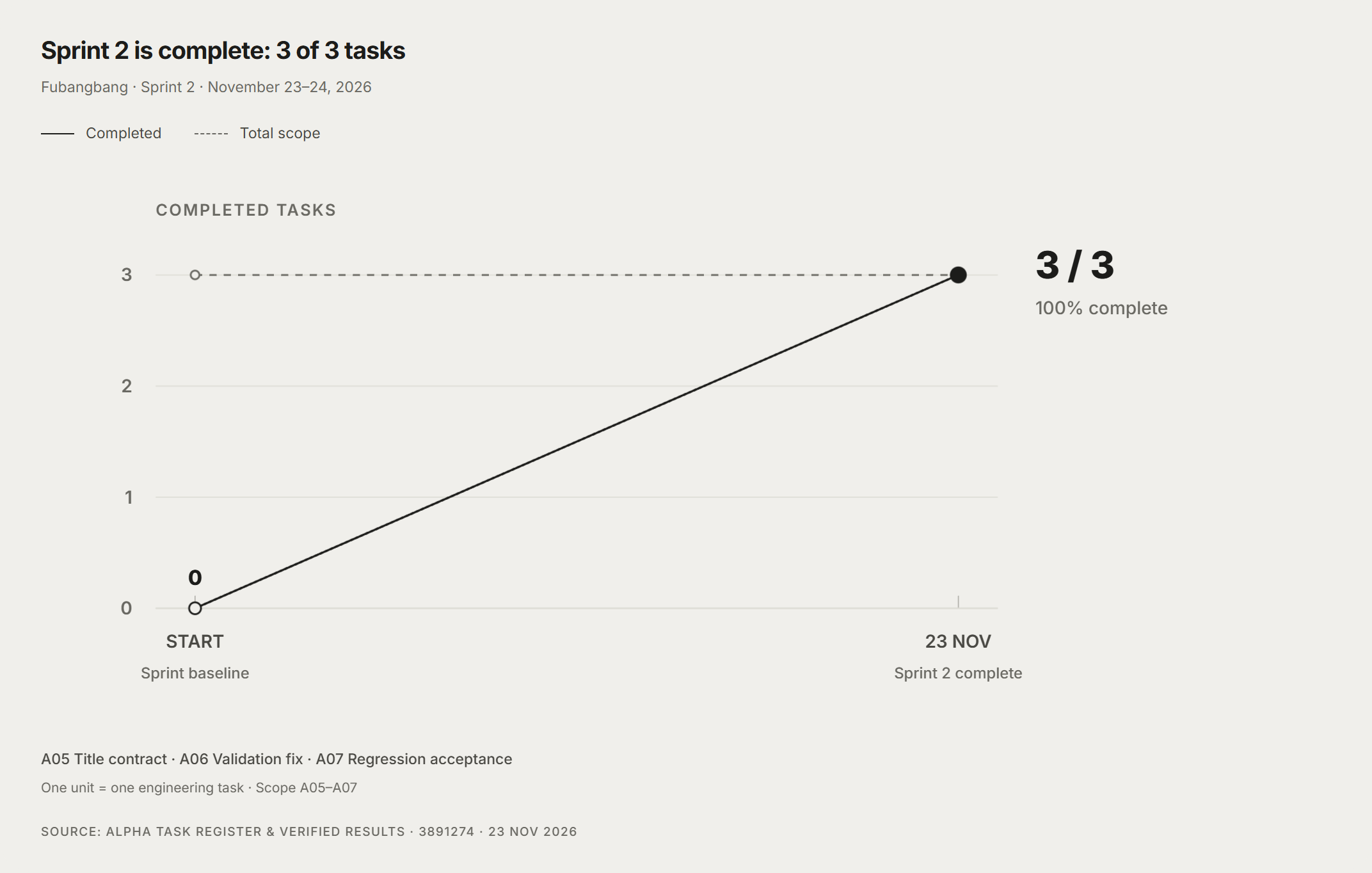
Figure 6. A05, A06, and A07 are complete: shared title contract, implementation, and regression acceptance.
The starting point is the zero reference for this sprint's task register. The completed snapshot contains three accepted tasks. This chart uses an engineering-only scope; Sprint 1's separate eight-item work list also included reporting and repository activities.
5.2 Alpha Engineering Plan Seven of Twelve Complete

Figure 7. A01–A07 are complete, bringing cumulative Alpha progress to 7/12, or 58.3%.
| Alpha task range | Work | Status in this report |
|---|---|---|
| A01–A04 | Environment, existing checks, core-flow acceptance, and issue investigation | Complete |
| A05–A07 | Shared title contract, implementation, and regression verification | Complete |
| A08–A09 | Publishing-view extraction and affected-flow verification | Sprint 3 |
| A10–A12 | Final regression, delivery checks, and consolidated evidence | Sprint 4 |
The cumulative milestones are zero at the defined Alpha start, four at the Sprint 1 snapshot, and seven at the Sprint 2 snapshot. Each task has equal weight. These counts describe accepted engineering work packages rather than hours, effort, or the percentage of all application features implemented.
6 GitHub Record and Group Contributions
The final Sprint 2 version is commit 3891274, Sprint 2: unify product title validation and archive verification. PR #3 merged the changes into main and closed Issues #1 and #2.
The application remains under source/CampusLink/, with both frontend and backend source tracked in the same repository. Final records, test evidence, and the five runtime screenshots are organized under docs/sprints/sprint-2/, following the Sprint 1 archive layout.
The following team-reported allocation applies to Sprint 2.
| Group | Members | Main contributions | Share |
|---|---|---|---|
| Frontend and Backend | Chen Jiayuan, Chen Haoyang, Chen Junjie, Zhu Chaoyang, Zhou Qican, Zhu Mingqian | Title-rule confirmation, frontend/backend correction, regression integration, repository maintenance, and final code organization, with Chen Jiayuan and Chen Haoyang jointly leading technical coordination and integration. | 60% |
| UI and Presentation | Ye Jiahui, Zhang Sufang, Chen Zhijun, Wu Sifan | Burn-up chart presentation, task-scope and label checks, screenshot captions, and blog layout. | 25% |
| Testing and Execution Support | Chen Mohan, Chen Wei, Zeng Wenhan, Zheng Bowei | Organization of regression results, runtime images, issue-resolution evidence, and test-record references. | 15% |
| Total | 14 members | 100% |
Chen Jiayuan and Chen Haoyang jointly led the sprint. The table retains group-level percentages rather than assigning individual percentages. Test execution and browser capture used automated tool assistance; the testing entries concern result organization and review.
7 Sprint Review and Next Iteration
Sprint 2 turned the two title findings from Sprint 1 into a shared rule, an implementation, and repeatable regression evidence. The useful improvement is consistency: the same supplied title now receives the same treatment through creation and editing, and failed validation preserves stored data.
The normal workflows continued to pass after the change. The additional boundary cases also give later changes a way to detect accidental regressions in Unicode counting, whitespace handling, partial updates, and legacy-title behavior.
Sprint 3, November 25–26, will focus on A08 and A09:
- Select one responsibility in
Publish.vue, such as image-upload handling, for a focused extraction. - Preserve the title rule, payloads, draft behavior, image validation, and user feedback.
- Repeat publication, editing, upload, draft, and failed-request recovery checks.
- Record the actual code changes, verification results, and running images for the next sprint.
相关推荐
复现基于量化状态反馈+非线性自适应神经控制的反馈系统(不确定MIMO)仿真(Matlab代码实现)
内容概要:本文介绍了一种结合量化状态反馈与非线性自适应神经控制的先进控制策略,用于解决不确定多输入多输出(MIMO)反馈系统的建模与控制问题,并基于Matlab平台实现了完整仿真。该方法利用神经网络逼近系统内部不确定性,融合量化反馈机制以增强系统鲁棒性与自适应能力,有效应对模型不精确、外部扰动等复杂工况,适用于高精度控制场景。文章强调科研需兼具严谨逻辑与创新思维,提供从理论推导到代码实现的完整学习路径,并配套丰富的仿真资源与技术文档,帮助读者系统掌握先进控制算法的设计与应用。; 适合人群:具备自动控制理论基础、神经网络初步知识及Matlab编程能力,从事控制工程、系统科学、机器人、自动化或相关领域的研究生、科研人员及工程技术人员。; 使用场景及目标:①研究不确定MIMO系统的稳定性与控制性能优化;②掌握自适应神经控制与量化反馈的集成设计方法;③应用于机器人控制、飞行器导航、工业过程控制等高精度动态系统控制场景; 阅读建议:建议结合提供的网盘资料(含代码与文档)与公众号“荔枝科研社”资源,按照目录顺序系统学习,注重理论分析与仿真实践相结合,通过动手复现算法深入理解其动态响应特性、收敛机制与鲁棒性能表现。
西周BC996年世界历史地图矢量文件SHP格式.zip
本资源为《西周BC996年世界历史地图矢量文件SHP格式》压缩包,文件大小约 28.70 MB,便于集中下载、整理和使用。具体内容请结合压缩包内的实际文件与说明查看。 在当前可读取的目录中,可见属性表(.dbf)、投影说明文件(.prj)、Shapefile 主文件(.shp)、Shapefile 索引(.shx)。建议解压后保持原有目录结构,先浏览文件清单与说明,再选择需要的资料进行加载或整理。 应用方面,可根据实际资料用于学习练习、资料检索、研究整理或项目参考。使用时可先确定所需内容,建立清晰的文件分类,再按项目要求进行筛选、转换与汇总。 使用 Shapefile 数据时,请把实际配套的 .shp、.shx、.dbf 等文件保存在同一目录,并保持同名关联;加载后再检查坐标系与中文字段显示。如需叠加其它数据,请先统一坐标与字段口径。 数据来源、时间范围、坐标系、字段定义、精度和使用条件,请以实际文件及原始说明为准。本介绍不对文件名之外尚未核实的信息作额外承诺。
智慧工业园区AI大模型数字化平台建设方案.docx
智慧工业园区AI大模型数字化平台建设方案.docx
基于 SpringBoot、Vue、Mybatis、RabbitMq、Mysql、Redis 等开发的轻量级的物联网综合业务支撑平台 支持物联网卡、物联网模组、卡+模组融合管理
基于 SpringBoot、Vue、Mybatis、RabbitMq、Mysql、Redis 等开发的轻量级的物联网综合业务支撑平台。支持物联网卡、物联网模组、卡+模组融合管理。提供状态、资费、客户、进销存、合同、订单、续费、充值、诊断、账单等功能。平台可同时接入中国移动、中国电信、中国联通、第三方物联网卡进行统一管理。逐步完善平台,助您快速接入物联网,让万物互联更简单。
西周BC845年世界历史地图矢量文件SHP格式.zip
本资源为《西周BC845年世界历史地图矢量文件SHP格式》压缩包,文件大小约 24.44 MB,便于集中下载、整理和使用。具体内容请结合压缩包内的实际文件与说明查看。 在当前可读取的目录中,可见属性表(.dbf)、投影说明文件(.prj)、Shapefile 主文件(.shp)、Shapefile 索引(.shx)。建议解压后保持原有目录结构,先浏览文件清单与说明,再选择需要的资料进行加载或整理。 应用方面,可根据实际资料用于学习练习、资料检索、研究整理或项目参考。使用时可先确定所需内容,建立清晰的文件分类,再按项目要求进行筛选、转换与汇总。 使用 Shapefile 数据时,请把实际配套的 .shp、.shx、.dbf 等文件保存在同一目录,并保持同名关联;加载后再检查坐标系与中文字段显示。如需叠加其它数据,请先统一坐标与字段口径。 数据来源、时间范围、坐标系、字段定义、精度和使用条件,请以实际文件及原始说明为准。本介绍不对文件名之外尚未核实的信息作额外承诺。